
Let AI ask you the questions
Your brain finds better answers when someone asks. What psychology and the AI studies say, and five ways to turn AI into your interviewer.
This issue can be read, or lived.
Not in the mood to read? Live it instead: a 2-minute story on your phone, where your choices change what happens next.
You've been looking for an idea for weeks. What if the right question was all it took?
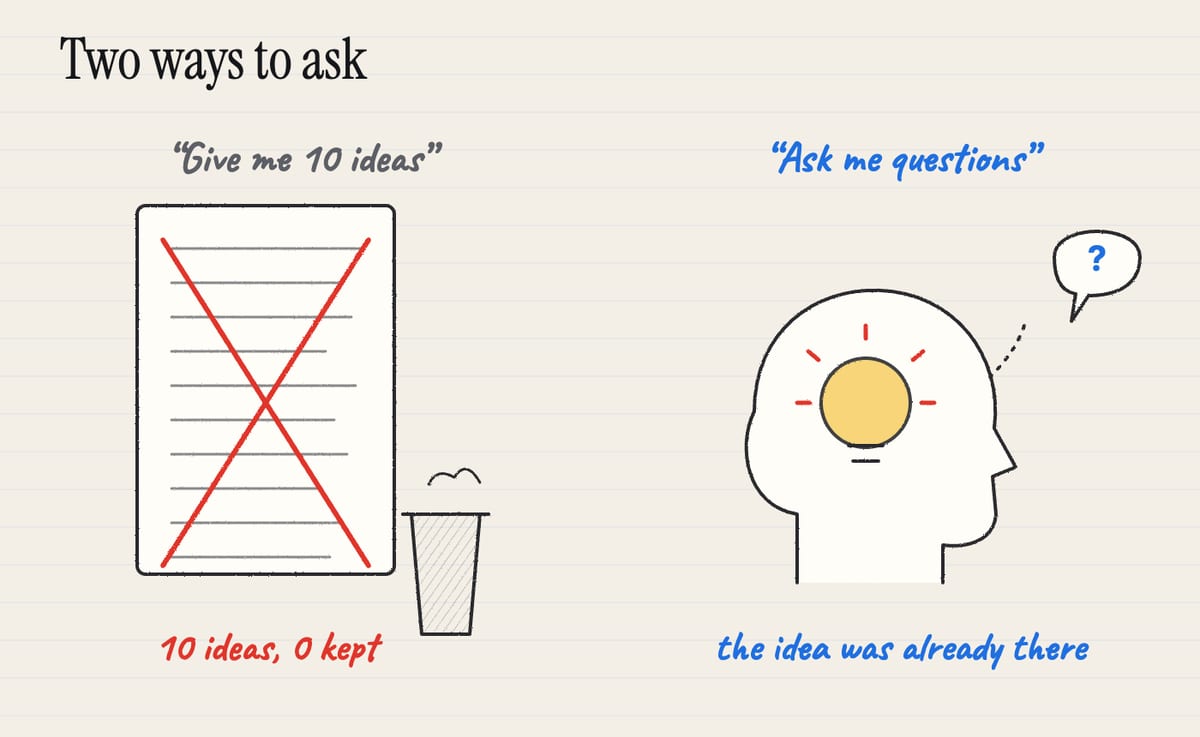
Have you ever asked AI for ten ideas?
Ten ideas for a video. A product name. Something new to launch this year.
You get them in four seconds. All reasonable, all nicely written.
And you don't keep a single one.
The AI did its job well.
The problem is that it answered for you. The answer you actually cared about was already, at least partly, in your head.
It just didn't know how to go looking for it.
This issue is about a very simple switch that almost nobody makes.
Stop asking AI for answers. Ask it to ask you questions.
There's more to it than a prompt trick. It's about how the human brain works, and psychologists have been measuring it for decades.
What your brain does when someone asks
Three research findings explain most of it.
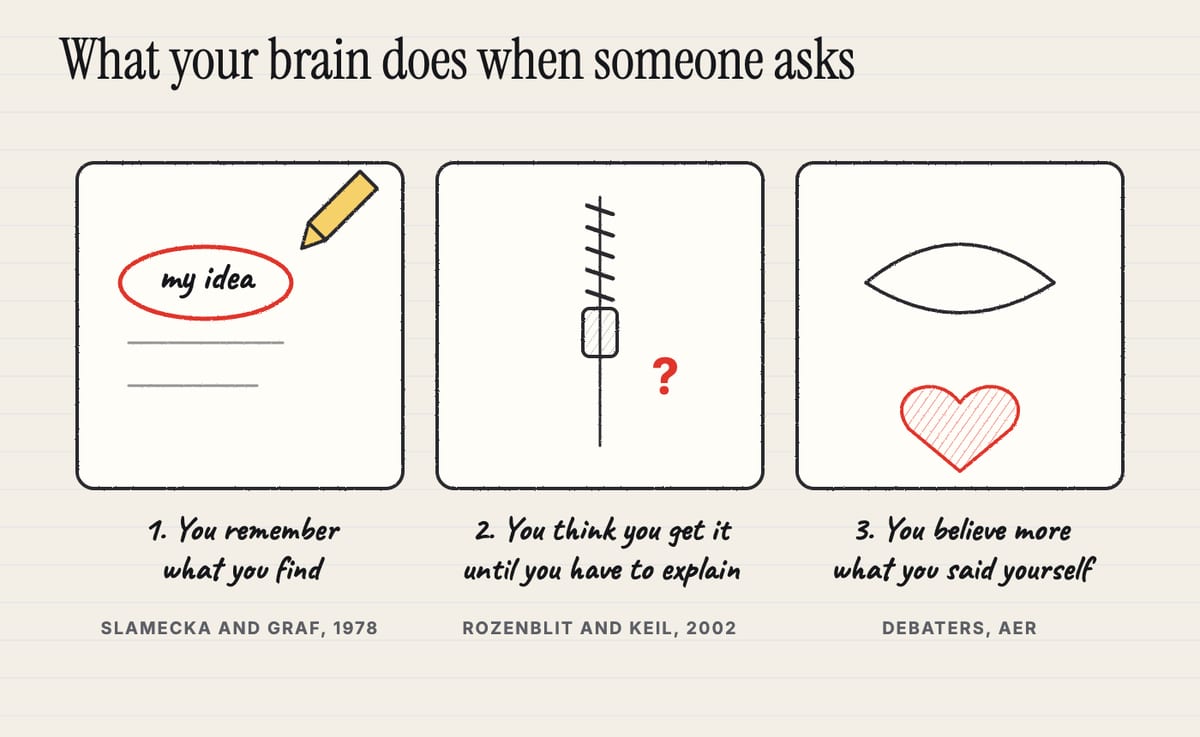
1. You remember what you come up with yourself.
In 1978, two psychologists, Slamecka and Graf, compared people who read words with people who had to find them from a clue.
The ones who had to find them remembered them far better.
It's called the generation effect, and it has been replicated in more than two hundred studies since.
What you find yourself, you keep. What you're handed, you forget.
2. You think you understand, until you have to explain.
Ask someone if they know how a zipper works. They'll say yes.
Now ask them to explain it step by step. Most stop halfway through.
Researchers call this the illusion of explanatory depth (Rozenblit and Keil, 2002).
Your project, your offer, your next video: you feel like you know what you want. One good question shows you in ten seconds what's missing.
3. You believe what you said yourself.
A study published in the American Economic Review followed debaters at international competitions, who were assigned a side at random.
After arguing for a position, they believed in it more.
Nobody convinces you better than you do.
That's exactly what good therapists, good coaches and good consultants do.
Instead of giving you the answer, they ask the question that helps you find it.
And that's why you actually follow through.
What the studies on AI say
We now have numbers on AI itself. They point the same way.
A thousand students and ChatGPT.
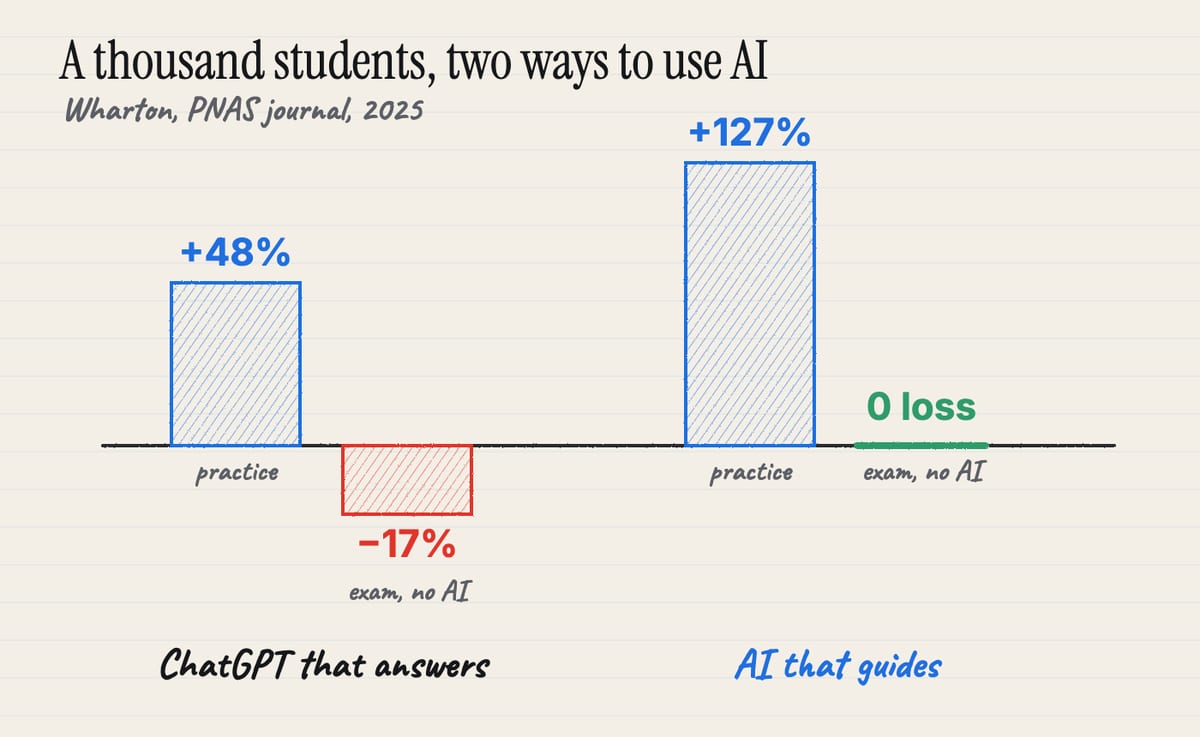
In 2025, researchers at Wharton (University of Pennsylvania) published an experiment in PNAS with nearly a thousand high school math students (the study).
With regular ChatGPT, their practice scores went up 48%.
But on the exam, without AI, they did 17% worse than students who had never used it.
A second group used a version set up to guide them without giving away the answer. They lost nothing on the exam.
Harvard students.
The same year, a Harvard physics course compared a very well-taught class with an AI tutor designed to ask questions rather than answer them (the study).
With the tutor, students learned more, and faster.
Professionals at work.
A Microsoft and Carnegie Mellon study of 319 knowledge workers (the summary) found that the more people trust AI, the less they think about what it produces.
So the same AI can make you sharper, or put you to sleep.
It all depends on who's asking the questions.
The technique: make AI your interviewer
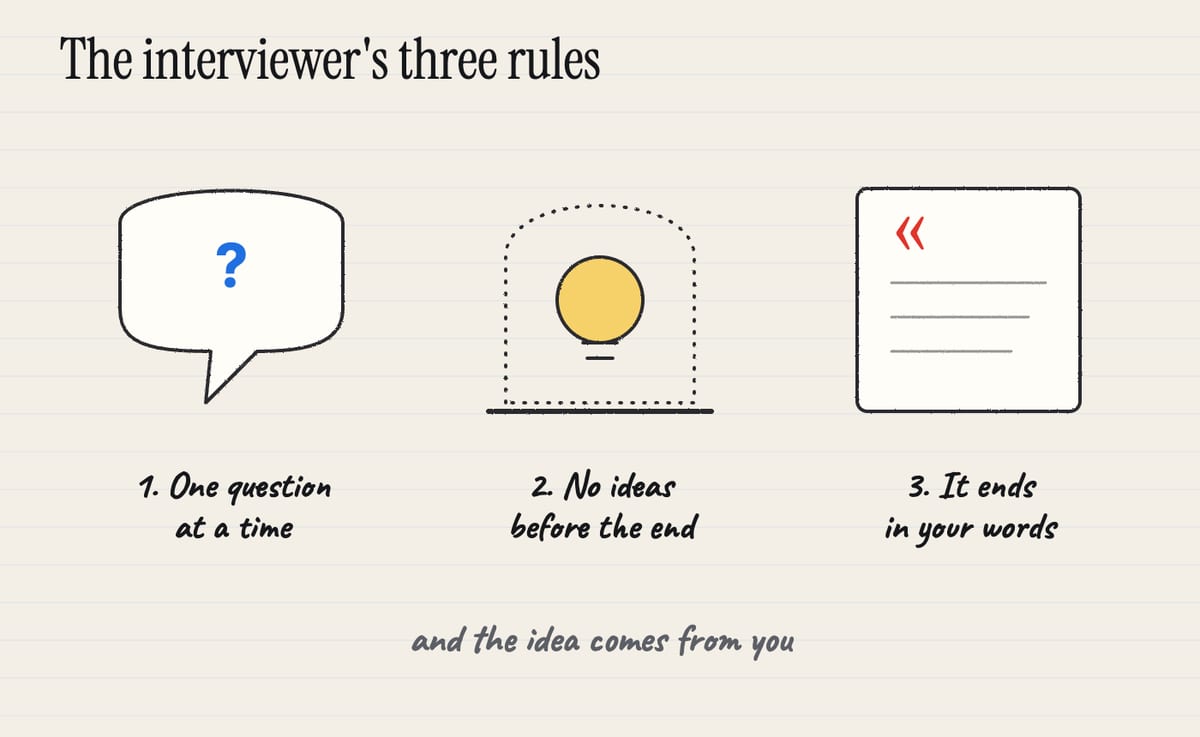
Three rules are enough.
One question at a time. Ten questions at once, and you answer fast and badly. One, and you actually think.
No ideas before the end. Until the interview is over, it isn't allowed to suggest anything. Otherwise it nudges you toward the average, and you follow.
It ends with your words. At the end, it sums up what you said, in your own phrasing, before proposing anything. You'll often see the idea show up in that summary.
Here's the base prompt. Copy it and replace what's in brackets:
You are my interviewer. Your job is to help me find my own answer, not to give it to me.

MY TOPIC
[what you want to find, decide or write]

WHAT YOU KNOW ABOUT ME
[your job, your situation, your constraints]

HOW YOU GO ABOUT IT
1. Ask me one question at a time, and wait for my answer.
2. Look for facts: an example, a client, a number, a specific moment.
3. If my answer is vague, follow up with "For example?" or "Why?".
4. Don't suggest any idea before the end of the interview.
5. After 7 questions, or when I say "stop", sum up what I said using my own words, then suggest 3 directions drawn only from my answers.
Five situations where it changes everything
The same technique, in five very different contexts.
For each one, just add the line below at the end of the base prompt.
1. Writing a video script.
Asking "write me a script" gets you everyone's script. Get interviewed on what you want people to feel, and on the true story you have in mind.
Start by asking me what the viewer should feel at the end, then help me find a true story I lived.
2. Choosing something new to do this year.
This is where AI gives its most generic answers. Yet you already know what you enjoy doing, what clients already ask you for, and what you refuse to do.
Ask me what people already request without my offering it, and what gives me energy or drains it.
3. Finding a new product for your clients.
The best offers come from your clients' own words. AI can help you dig them out of your memory.
Have me walk through my last three client conversations, and point out the problems they described that I didn't solve.
4. Making a hard decision.
Here, AI plays a bit of a therapist's role. It doesn't decide for you. It helps you see what you already think.
Help me separate what I know, what I fear and what I assume. Ask me what I would tell a friend in my situation.
5. Preparing a talk or a post.
Your point of view is what sets you apart. The interview brings it out before AI writes a single word.
Find the view I hold that most people in my field don't share.
The limits, honestly
Three cases where this method isn't the right one.
When you need information. For a date, a tax rule or how a piece of software works, ask for the answer, then check it.
When you're in a hurry. A good interview takes ten to fifteen minutes. For a routine email, that's too much.
When the AI starts steering. A question can push you toward an answer. If you feel it leading you somewhere, tell it: "Ask open questions, without assuming the answer."
For everything else, try it once this week.
Take the question you've been going around in circles on for months. Paste the prompt. Answer honestly.
You'll be surprised by what you already knew.
Every week, a technique like this one in The Ergon Brief. Subscribe (it's free) to get the next issue.
See you soon,
Salim
Get The Ergon Brief every week