
The future has never been this blurry. Here's how to keep moving anyway.
The AI story has flipped 26 times in three years. The skill that matters now, and a small tool to build it.
I'll be honest with you: right now, I struggle to see very far ahead.
And I'm not the only one. Planning a career has never been easy, but with AI, we have crossed a line. The questions we used to ask over five years, we now struggle to ask over one.
I tried to draw what it feels like.
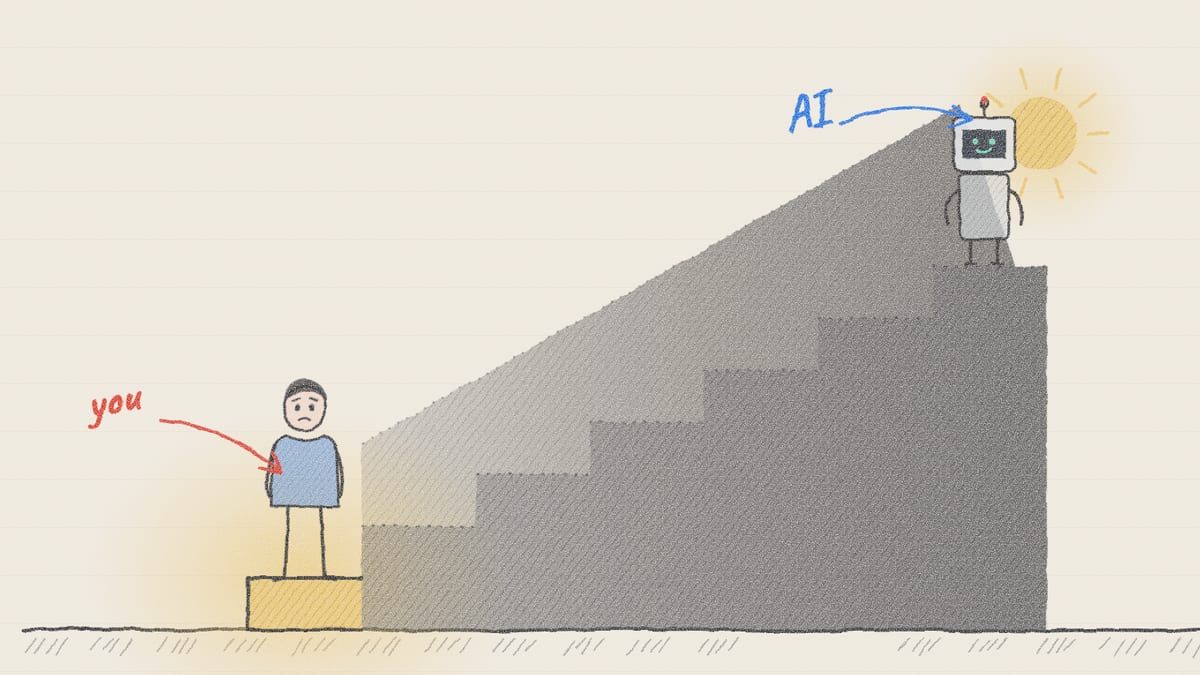
You are standing on a step, the only one in the light. In front of you, a staircase. And at the very top, AI, standing in front of the sun.
It doesn't stop you from climbing. It does something worse: it casts a shadow over every step that follows. You can see the next step. Rarely the one after.
That is actually why I write these emails. Every week, I try to see as far as I can, and bring back what I find. But before going any further, I owe you a confession.
AI has changed its story 26 times in three years
A team of analysts went through the headlines of eight major business outlets (Reuters, Bloomberg, CNBC, AP...) since May 2023. They counted how many times the AI story flipped from "boom" to "bubble", or back.
The answer: 26 times. Typically, one reversal roughly every three weeks.
The latest one was last week. On October 8, after a setback on OpenAI's revenue, AI was a bubble. On October 9, "AI bubble fears fade". And on the 13th, the IMF published a report warning that an AI-driven correction could shake the global economy.
Experts change their minds more slowly than markets, but they change them too. One day, AI is about to replace half of all jobs. Six months later, it's a bubble that will never deliver. Then a new model comes out, and the pendulum swings back.
You could conclude that the experts have no idea what they're talking about. That would miss the point entirely.
They don't change their minds because they're crazy or fickle. They change their minds because the ground keeps moving under their feet. What was true in spring no longer holds in autumn: the tools improve, prices drop, uses that looked solid collapse, new ones appear overnight.
That goes for me too: what I write to you today, I may well nuance in six months.
When everything moves this fast, having been right once is worth almost nothing. What is worth something is something else.
The skill nobody teaches
It isn't prompting. It isn't knowing the latest tool. Those expire within months.
It's being ready to change your mind, quickly, and to bounce back.
It sounds simple. It isn't. We are all attached to our opinions, especially the ones we've defended in front of our team, our boss or our clients. Changing your mind feels like admitting defeat.
Here is a small tool that helps me a lot: put a date on your certainties.
Instead of thinking "AI can't do my job", think "as of October 14, AI can't do my job". Write it down somewhere. Read it again in three months.
It sounds trivial. But a dated certainty is much easier to update. It wasn't wrong: it was true on a given date.
Five moves for climbing without seeing everything
In practice, here is what I do, and what I'd suggest:
- Break your work down into tasks. "Will my job disappear?" is too big a question: all it produces is anxiety. "Which tasks in my week does AI already do well?" is a question you can answer tonight.
- Test AI on whatever worries you. Instead of reading predictions, try it. Within an hour, you'll know whether your fear is justified, and you'll have an opinion worth more than any expert's on your job: your own.
- Double down on what makes you different. Your perspective, your relationships, your taste, your quirks. That is precisely what AI imitates worst.
- Change one task a month. Not everything at once. One task, handed to AI or taken back. Then see what happens, and date your conclusion.
- Judge your week, not your career. Nobody can see a whole career right now. A week, you can. And weeks are what careers are made of.
Notice something: none of these moves requires knowing where the staircase leads. They let you climb one step, look around, and adjust.
The light is closer than you think
Accepting that the future is blurry is not giving up. It means no longer waiting for a certainty that won't come.
The people who will do best won't be the ones who saw it all coming. They'll be the ones who climbed the most steps, correcting course at every landing.
The light is never very far away: it's on the next step. That's where I'll meet you every week.
Talk soon,
Salim
The Ergon Brief
Get The Ergon Brief every week