
The skill AI makes more valuable than ever
I figured it out after weeks of making videos with AI. What it is, why it will set people apart, and how to build it.
Over the past few weeks, I've spent a good part of my spare time learning a new craft with AI.
And it taught me something I can't get out of my head.
You know how fast the world of AI moves.
What was true six months ago sometimes isn't anymore.
Some principles we thought were solid have fallen by the wayside.
But others hold up. And I try to share them with you here, issue after issue.
Today's one, I believe, will matter more than all the others.
It's a skill.
The one that, in my view, will separate everyone who uses AI.
AI keeps getting easier to use. Everyone will have access to it.
But this particular skill doesn't come with a subscription.
And it isn't easy to build.
So today, I'm going to tell you what it is.
I'll show you how I discovered it, what research says about building it, and how I go about it myself.
Everything I'm about to tell you comes from here
For a few weeks now, I've been learning to create images and videos with AI.
The creative side, the one you rarely see in this newsletter.
And for that, I relaunched an Instagram page I had set aside: Access Imagination.
It turns everyday scenes into little magical worlds.
Before reading on, I'd love for you to watch these two videos. Each one is under 20 seconds.
First, because I think you'll enjoy them.
Second, because everything that follows will make a lot more sense once you've seen them.

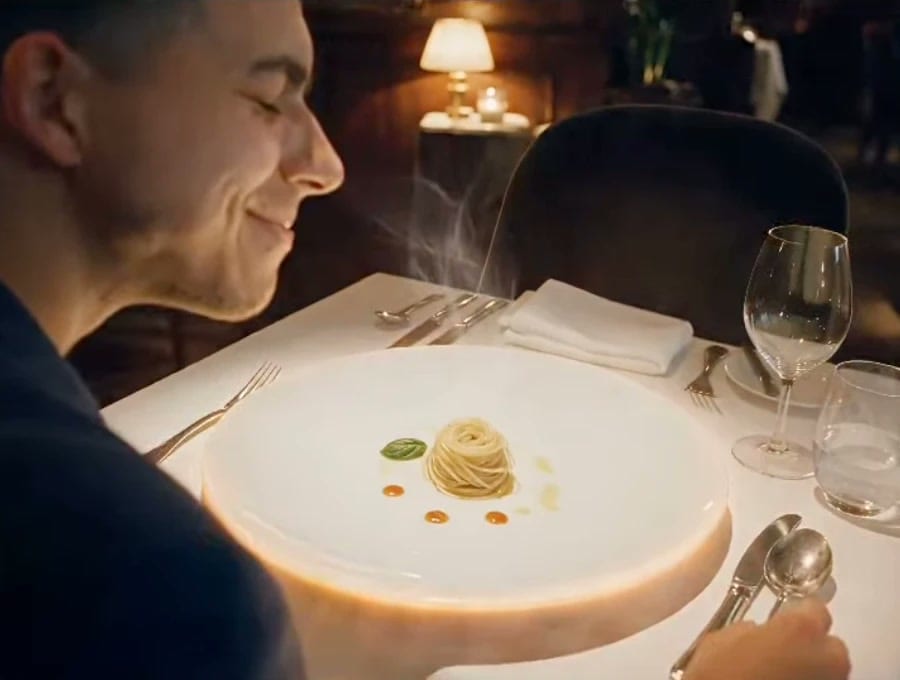
Making these videos is what made me realize what I wanted to talk to you about today.
(By the way, feel free to follow this Instagram page. The page already has 38,000 followers, who came from older posts I made about 3 years ago, on the same idea. Scroll down a little to see them: you'll see how far AI image and video tools have come in two or three years. It's wild. This one, for example.)
The technical part is quick to learn
When you start making AI videos, you think it will all come down to technique.
The right tools. The right settings. The right prompts.
I picked up the basics fairly quickly.
(I also made plenty of mistakes. Expensive ones, believe me. If you're interested, I'll tell you about them in a future email, so you don't make them too.)
But once I had the technique down, I ran into the real problem.
For a single scene, I generate several versions.
Four, five, sometimes ten.
They're all decent.
And I have to keep one.
The one that will stop the thumb of someone scrolling through Instagram.
At that point, no setting can help you.
What makes the choice is your taste.
Taste
That's the skill I wanted to tell you about.
Taste. Good judgment. Knowing what's good when you see it.
I've been saying it here for a long time: when AI can do everything, knowing how to choose becomes essential.
But I had never felt it as strongly as while making these videos.
And thinking about it, I find it everywhere in my work.
I'm redoing my company's website. AI can build websites. But which version is the right one? And what inspiration do I give it to start with?
I ask it for a presentation. It makes one in a minute. But how do I know it's any good?
I ask it for a text to win over a client. It writes me three. Which one do I keep?
AI produces, and it's up to you to judge.
There are two kinds of taste
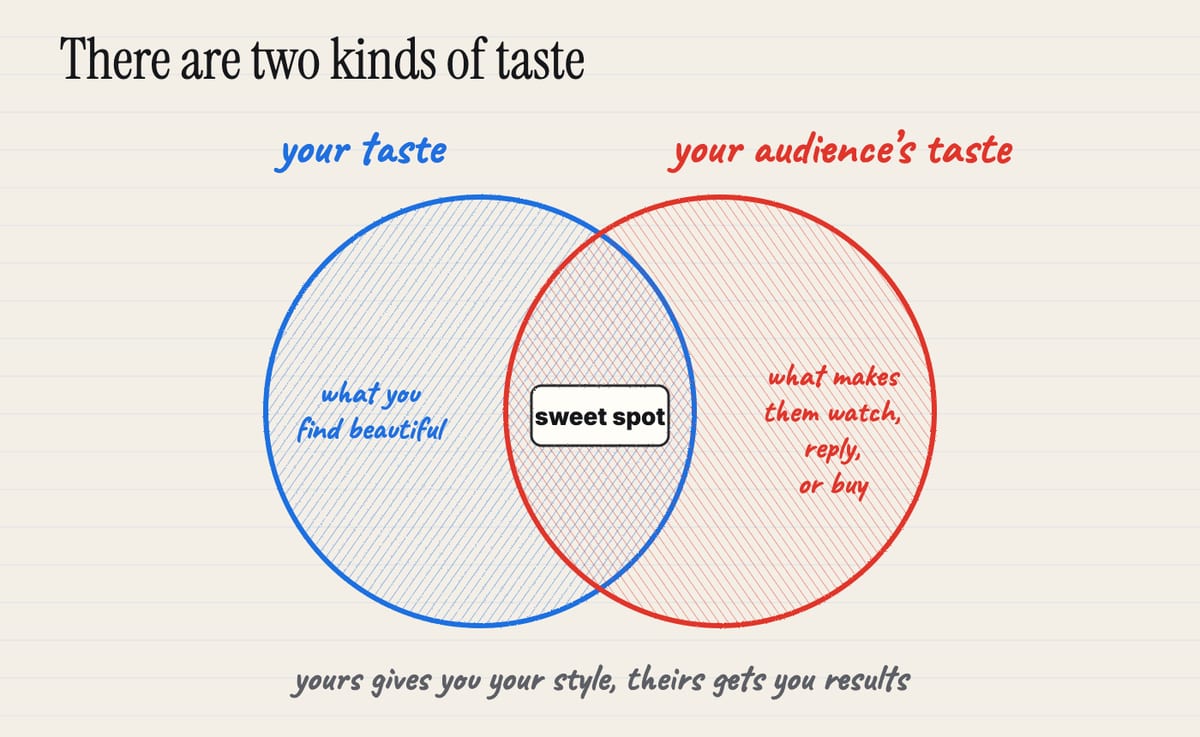
When I talk about taste, I mean two different things.
The first is yours. What you find beautiful, right, well made.
The second is the taste of the people you're trying to reach. Your clients. Your audience. The people who will read, watch, buy.
And the two don't always match.
A video can delight me and go nowhere on Instagram.
A presentation can feel elegant to me and leave my client completely cold.
The taste that really counts at work is the second one: knowing what will land with the people you're trying to reach.
Yours still matters. It's what gives you your style.
But it's the second one that gets results.
Why it counts twice with AI
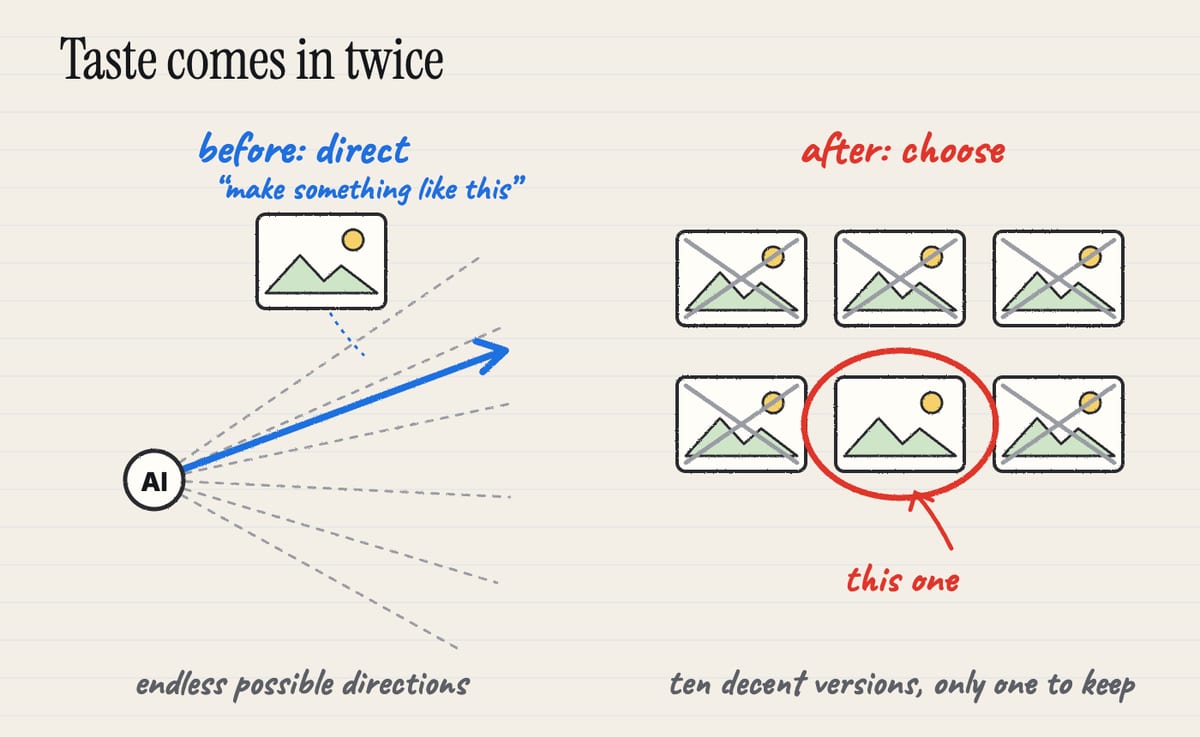
Taste comes in at two moments.
Before, to give direction. AI has endless possibilities in front of it. If you don't point it somewhere, it picks the most average one. Telling it "make something like this", showing it the right example, the right reference: that's already taste.
After, to choose. It gives you several results. You need to know which to keep, which to throw away, and what to ask it to fix.
Before AI, producing took time. You'd make one version, maybe two.
Today, you can get ten in a minute.
The more AI produces, the more choosing becomes the real work.
How taste develops
I wondered whether taste was a gift.
Part of it may be.
But research mostly shows that it can be trained.
First example: chess players. In a famous experiment from the 1970s, masters and beginners were shown a chess position for five seconds. The masters rebuilt it almost perfectly, the beginners far less so. But when the pieces were placed at random, the masters' advantage almost vanished. Their eyes weren't better. They had seen thousands of real games, and they recognized what made sense.
Second example: paintings. In 2008, two researchers taught students to recognize the styles of twelve painters. One group saw the paintings artist by artist. The other saw them mixed together, side by side. The second group got much better at recognizing the styles. And most participants were convinced of the opposite.
Taste is built by seeing lots of examples, and above all by comparing them.
There's also an idea I love, often told by the American radio host Ira Glass.
When you start doing something creative, your taste is usually better than what you can actually make. You can see your work isn't good enough yet, and that's frustrating.
With AI, that gap changes shape. It can produce at the level of your taste, sometimes even above it.
So your taste becomes the limit.
How I go about it
In my experience, taste mostly comes from exposure.
But conscious exposure.
For my videos, that means spending time on Instagram. Just not the way I used to.
I watch the videos that work. I watch them again. I ask myself why this one stopped me and the one before didn't.
And over time, my eye learns to tell what works from what doesn't.
It's the same in any line of work.
Want to know what a good presentation looks like? Look at the ones that convinced people, and the ones that didn't.
Want to write a good sales script? Go read the ones that actually sell.
Want a great website? Open ten sites in your industry, and note what the best ones have in common.
To build your taste, looking better matters more than producing more.
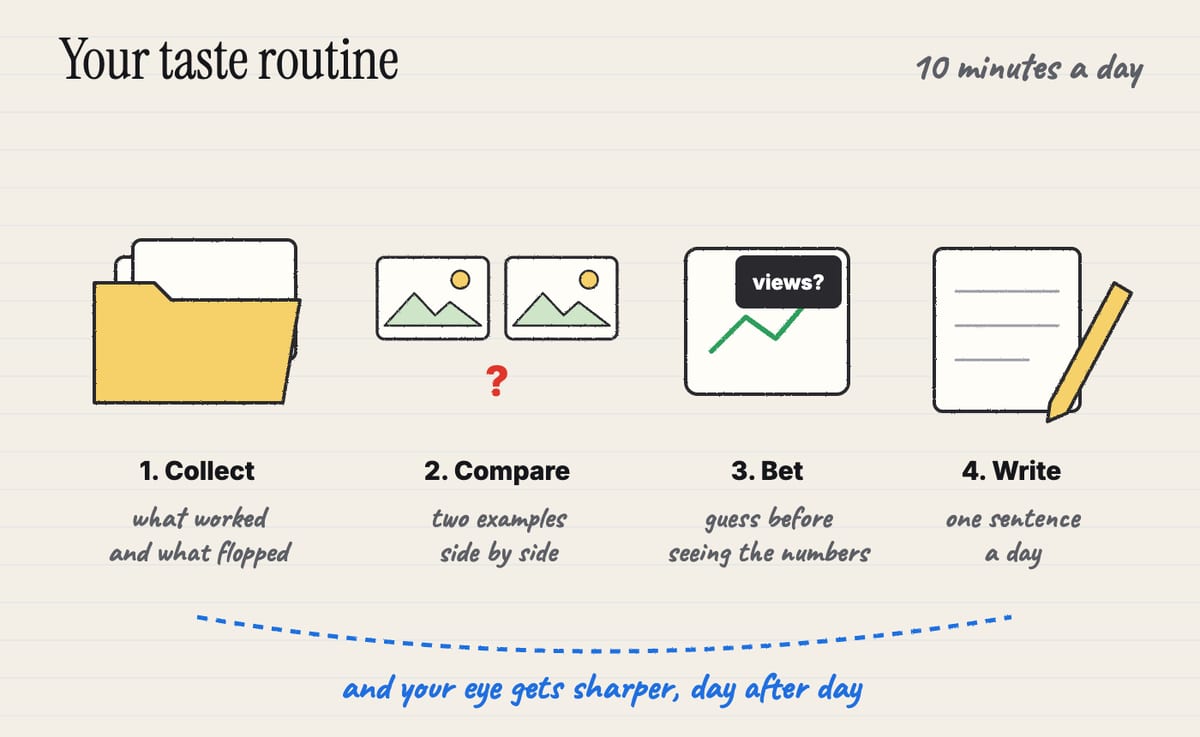
Keep this: your taste routine
Ten minutes a day, in the area where you want to improve.
- Collect. Keep a folder of examples that worked in your field (a presentation that won people over, an ad that stopped you, an email everyone replied to). And the ones that didn't work, too.
- Compare side by side. Two examples at a time. What makes one work and not the other?
- Bet before you look. Before you see the results (the views, the sales, the replies), guess which one will work. Then check. That's how your eye gets calibrated.
- Write down what you learned. One sentence. Over time, those sentences become your own taste guide.
And when you work with AI, use it to train your eye rather than to choose for you:
I need to create [what you need to produce: a presentation, a text, a web page] for [the people you're trying to reach].

Give me 4 versions that are genuinely different from each other, not 4 variations on the same idea.

Don't tell me which one is best. I'll choose myself and explain why.

Then tell me honestly what my choice says about my taste, and what I may have missed when it comes to [the people you're trying to reach].
You choose first. Then the AI challenges you.
Your taste does the work, and your taste is what grows.
And you, in what area would you like to build your taste? Subscribe to the Brief (it's free) and reply to any of our emails: I read everything.
AI is about to make production almost free.
What will keep its value is knowing what to ask for, and what to keep.
Talk soon,
Salim
PS: If you enjoyed these videos, feel free to follow Access Imagination. The page already has 38,000 followers, from older posts I made about three years ago, on the same idea. Scroll down a little to see them: you'll see how far AI image and video tools have come in two or three years. It's wild.
Get The Ergon Brief every week