The return of privacy
Cameras and social media had almost taken it from us. AI might give it back, after a messy transition. My take, open for debate.
This issue can be read, watched, or lived.
Not in the mood to read? Here's the video version: a few minutes that cover almost everything below (pick the English audio track in the settings if YouTube doesn't do it for you).
Or live it: a 2-minute story on your phone, where your choices change what happens next.
When a suspicious video goes around your family, who plays fact-checker: you, someone else, or nobody?
My mom often sends me videos she's seen on Instagram.
A dog saving a child from drowning. A celebrity announcing something unbelievable.
And every time, I play the same role: the fact-checker.
"Mom, that one's AI."
"What about this one?"
"Also AI."
It makes me smile. But after a while, an idea started nagging at me.
I think AI is giving us back something we thought we'd lost a long time ago.
Our privacy.
I know. Right now, you mostly hear the opposite.
I'm not claiming to be right. I'm sharing my reasoning, because I find it interesting, and because it has very concrete consequences for our work.
The right to privacy was born because of a camera
I came across a piece of history while preparing this email, and it stuck with me.
In 1890, two American lawyers, Samuel Warren and Louis Brandeis, published an article that went on to found the right to privacy in the United States.
What worried them were the new portable cameras, which let anyone photograph you without you posing, and the newspapers printing those pictures.
In other words, privacy became an issue the day it became easy to capture people.
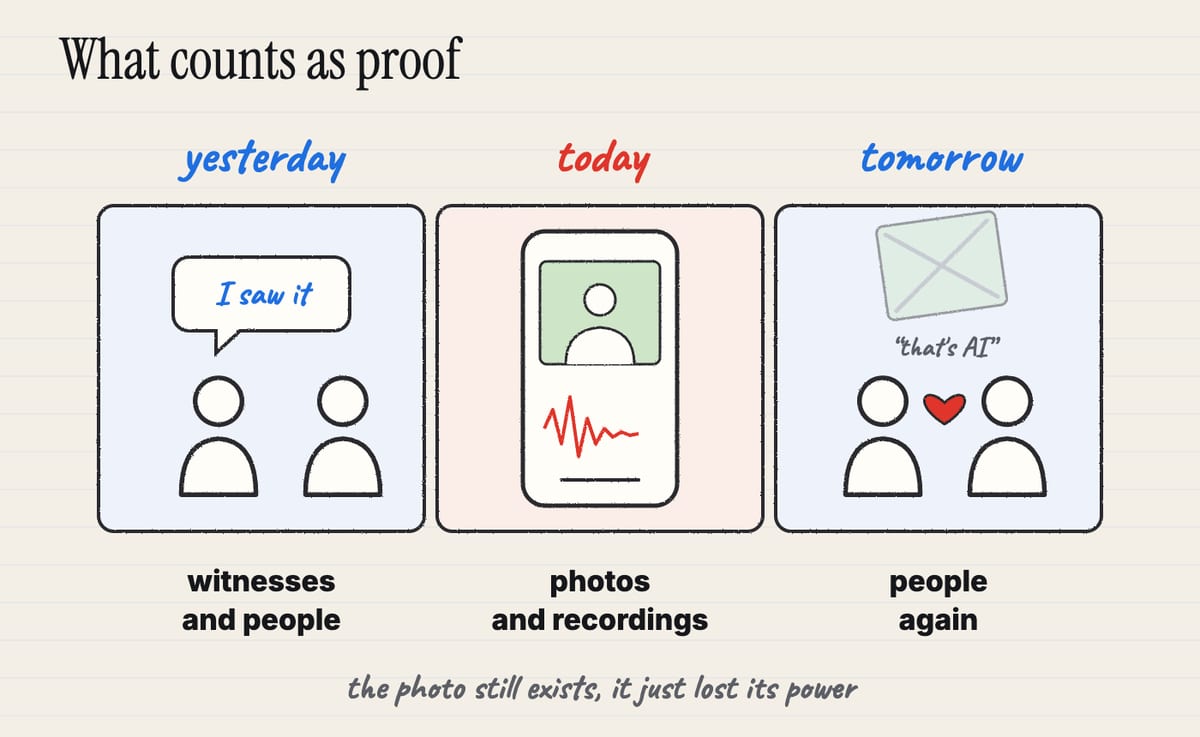
Before that, most of what you did left no trace. To prove something, you needed witnesses.
I'm not saying it was better. It was easier to protect your private life, and it was also easier to deny what you had actually done.
Then everything became evidence
A century later, phones and social media arrived.
Today, anyone can take your picture without you noticing, record your voice, screenshot your message, and send it to thousands of people in a second.
And all of it counts as proof.
"I've got the photo." "I've got the recording."
For about twenty years, what we saw online was treated as true by default.
That's what cost us a good share of our privacy.
The strange moment we're living through
Then AI arrived.
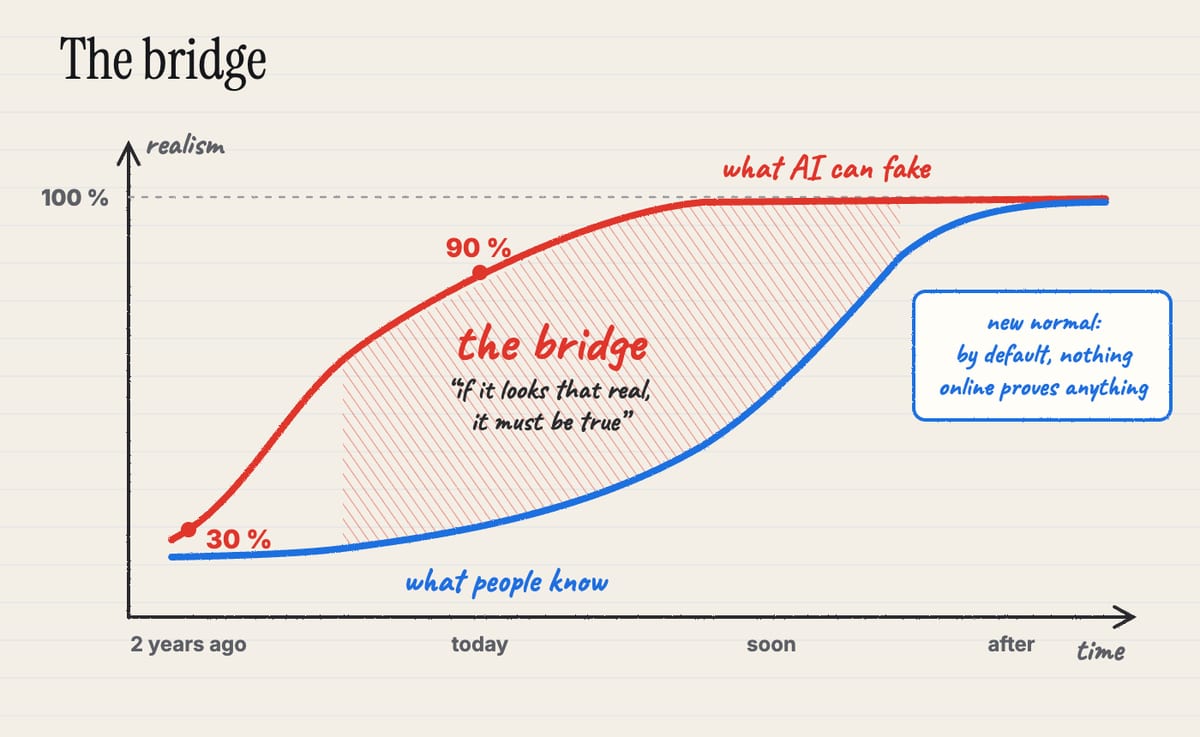
Barely two years ago, you could spot a generated image right away. Six-fingered hands, faces that were too smooth.
Today, in my view, we're at about 90%.
For voices, it may already be done. In a study published in September 2025, researchers at Queen Mary University of London played cloned voices to participants. People took them for real human voices 58% of the time. Each clone had been built from about four minutes of recordings.
With images, there are still giveaways, if you know where to look. That's why I can still play fact-checker for my mom.
But it's moving fast. I think it won't be long before we hit 100%, or close to it, and nobody will be able to tell the difference with the naked eye.
The bridge, the dangerous stretch
There will be a moment when AI can fake everything, while a large share of people don't know it yet.
They'll think: "If it looks that real, it must be true."
And during that stretch, there will be a lot of abuse. Fake evidence, and cloned voices asking a loved one for money.
It has already started.
In January 2024, an employee of Arup, the British engineering firm, made fifteen transfers in Hong Kong, for a total of about 25 million dollars. He thought he was on a video call with the CFO and several colleagues. Every one of them was an AI fake.
In the United States, the FBI counted nearly 900 million dollars in losses from AI-powered scams in 2025. It was the first time its annual report gave them their own category.
People over 60 filed only about 14% of those complaints. But they suffered almost 40% of the losses, over 350 million dollars.
When I read that last number, I thought of my mom.
There's also a quieter, opposite effect. Two American law professors called it the "liar's dividend." When anything can be fake, anyone can wave away real evidence: "That's AI."
On the bridge, the fake becomes believable, and the real becomes deniable.
And then what?
I think this stretch will be hard. But I also think it will pass.
After enough scams in the news and enough explanations around the dinner table, almost everyone will get it.
And we'll land in a new shared normal, where by default nobody believes that a photo, a video or a recording seen online proves anything at all.
If you think about it, that looks a lot like before.
Before there was a camera in every pocket, a rumor stayed a rumor.
Tomorrow, a photo of you at a party or a recording of you losing your temper won't prove anything on its own. Anyone will be able to say "that's not me," and there will be no real way to know.
That's why I talk about the return of privacy. People will still be able to take your picture. The picture will simply have lost its power.
That will protect people. It will also protect some who don't deserve it.
And I could be wrong. Solutions are emerging to certify where an image comes from. Google's latest Pixel phones, for example, sign every photo the moment it's taken, using a standard called C2PA. And in Europe, since August 2, 2026, a rule in the AI Act requires deepfakes to be labeled when they're published.
If those signatures become universal, we may trust images again, as long as they're signed. For now, we're far from it. Not every manufacturer is on board, and most images going around carry no signature at all.
My conviction is that we'll believe less and less of what we see, and more and more of who we know.
What it changes for your work
1. Trust becomes your real capital again.
If an image no longer proves much, we go back to what used to prove things: people.
Your reputation, built over time, and what people have seen of you in real life.
A client will believe you because they know you, and less and less because they saw a nice video.
2. Real life gains value.
Meeting in person and word-of-mouth referrals are hard to fake. They're going to count for more.
3. Verification habits are for now, not later.
We're most exposed on the bridge, before everyone becomes suspicious.
An urgent transfer request, even in your boss's voice? You call back on another channel.
A voice message from a loved one in distress asking for money? You ask a question only they could answer.
A screenshot accusing someone? You treat it like a rumor until it's confirmed.
4. Show who you are over time.
If you communicate online, a single image will matter less and less. People will recognize you by your consistency, and by what others say about you.
And when someone wants to know who you are, they'll increasingly ask an AI. ChatGPT, or Google, which now answers with AI too.
What it says will depend on what it finds about you: a website in your name, articles, what other people have written. Making sure these tools know you well is what's called GEO, generative engine optimization. We've talked about it here a few times, and it's one more reason to understand how AI works.
If you give it nothing to read, it will fill the gaps with whatever it finds. Sometimes with the life of someone who shares your name.
Keep this: the anti-impersonation kit
Four habits to set up this week, at work and at home.
- A family password. A word or phrase only your loved ones know, to ask for if someone calls in an emergency with a familiar voice. It's what the FBI has been recommending since December 2024.
- The two-channel rule. Any request for money or sensitive access gets confirmed through a different channel than the one it came in on. A call gets checked by text, an email by a call.
- Less of your voice in public. A few minutes of audio are enough to clone a voice. That doesn't mean disappearing from social media, just thinking twice before posting long voice notes or videos of your family.
- One person to warn. A parent, a colleague, a friend who's less aware. Show them a few AI-generated images, and tell them about the family password.
And for your team, here's a prompt to draft a verification rule in a few minutes:
I work at [your company or team, in one sentence]. The sensitive requests we get are mostly [transfers, access, customer data, other].

Help me write a short verification rule, 5 points at most, to protect us from AI impersonation (voice, video, email).

It should be simple enough for everyone to remember, and spell out who to call, through which channel, and what to do when in doubt.

Ask me the questions you need first, one at a time.
So, whose fact-checker are you? Subscribe to the Brief (it's free) and reply to any of our emails: I read everything.
We spent twenty years believing everything we saw online.
We may spend the next few learning to trust people again, rather than images.
Talk soon,
Salim
PS: The sources, if you want to dig deeper. The cloned-voice study (Queen Mary, PLOS One, 2025), the Arup case (South China Morning Post), the FBI's 2025 numbers (Malwarebytes and Bitdefender) and the family password recommendation (FBI, IC3).
Get The Ergon Brief every week