
Hiring, or getting hired, in the age of AI
I'd rather pay someone twice as much (here's why)
This issue can be read, watched, or lived.
Not in the mood to read? Here's the video version: a few minutes that cover almost everything below (pick the English audio track in the settings if YouTube doesn't do it for you).
Or live it: a 3-minute story on your phone, where your choices change what happens next.
Those tasks AI does in two hours: is any of them worth a salary? You stack them, you decide.
A few weeks ago, I ran into a math problem I couldn't solve.
I was looking at everything that needed doing at Ergon. And for every task, I told myself: "I can do this in two hours with AI. I'm not paying someone for that."
Then I'd move on to the next one, and tell myself the same thing.
And yet, I couldn't do it all.
Tens of thousands of you read Ergon, and you ask us for a lot. Tools, formats, ways to help you day to day. Many of those ideas would be genuinely useful to you. But on my own, I didn't have the time to build them.
So I wanted to grow the team. Not with just anyone: with someone who would truly let us do more.
That's how I met Othmane. After a degree in mathematics, he graduated in AI from École 42, and since then he's been building in-house AI systems for professionals.
From our first conversations, we agreed on what matters. He doesn't let AI do everything for him, and he doesn't work without it either. And like us, he believes some things should never be handed over to AI, which is rare among people who work in this field.
He has joined Ergon.
And while looking for the right person, I understood why my math never added up. A few fundamental principles came back to me. Principles that apply just as much to finding a job as to finding someone to work with.
I don't think we talk about them enough. And in today's market, with AI becoming genuinely useful, they matter enormously.
So I'm sharing them with you, along with concrete tools: an exercise to figure out who to hire, an interview test, and a log to prove what you can do.
Whether you're looking for a job or for someone to work with you, now or in a few years, you'll come away with something to do this week.
The task-by-task trap
Once you get efficient with AI, this trap shows up fast.
You break the work into small tasks. Each one looks short with AI, so none of them justifies a salary.
As a result, you end up doing everything yourself. And everything that would really matter never gets done, because nobody has the time.
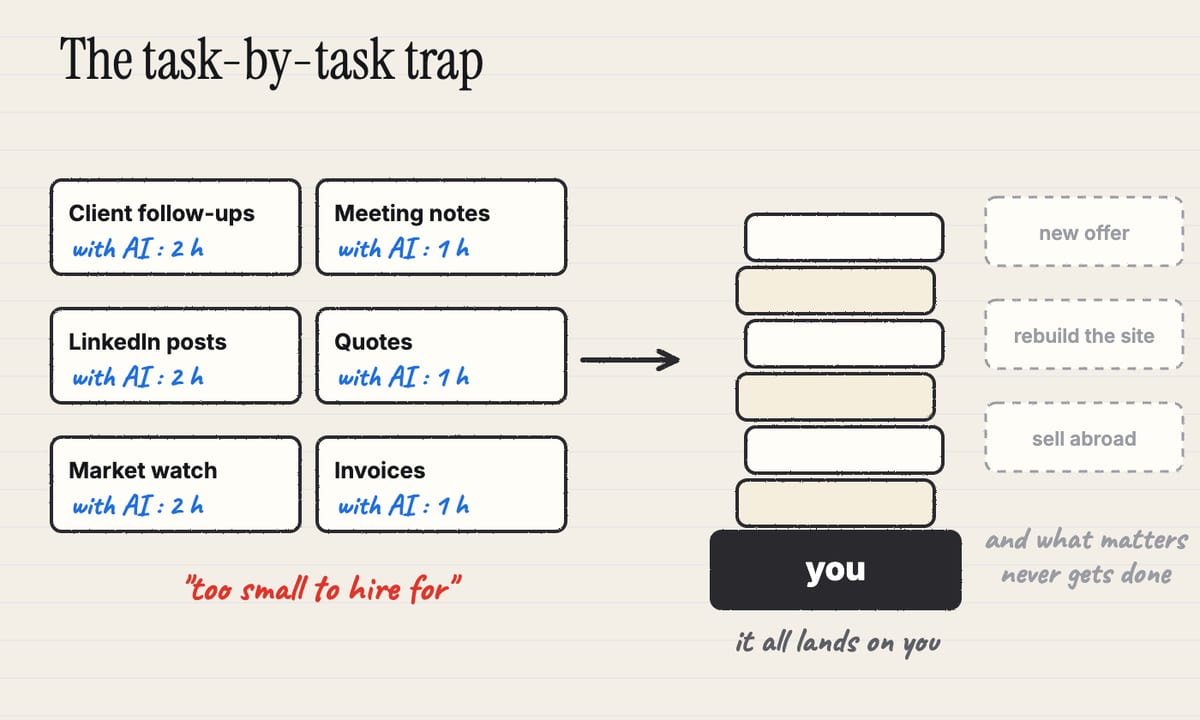
The math between what a person costs and what they bring has become much more subtle with AI.
Flip the math
For a long time, I was thinking about it backwards.
I started from my tasks, and asked who could do them for me.
Now I start from the other end. I ask what a full-time person would do, someone who knows their job well and really knows how to work with AI.
That person won't just take over my two hours a week.
They'll do in a few hours what used to take weeks, and spend the rest of their time on everything nobody had time for until now.
You no longer hire someone for what AI can do. You hire them for everything extra they'll do with it.
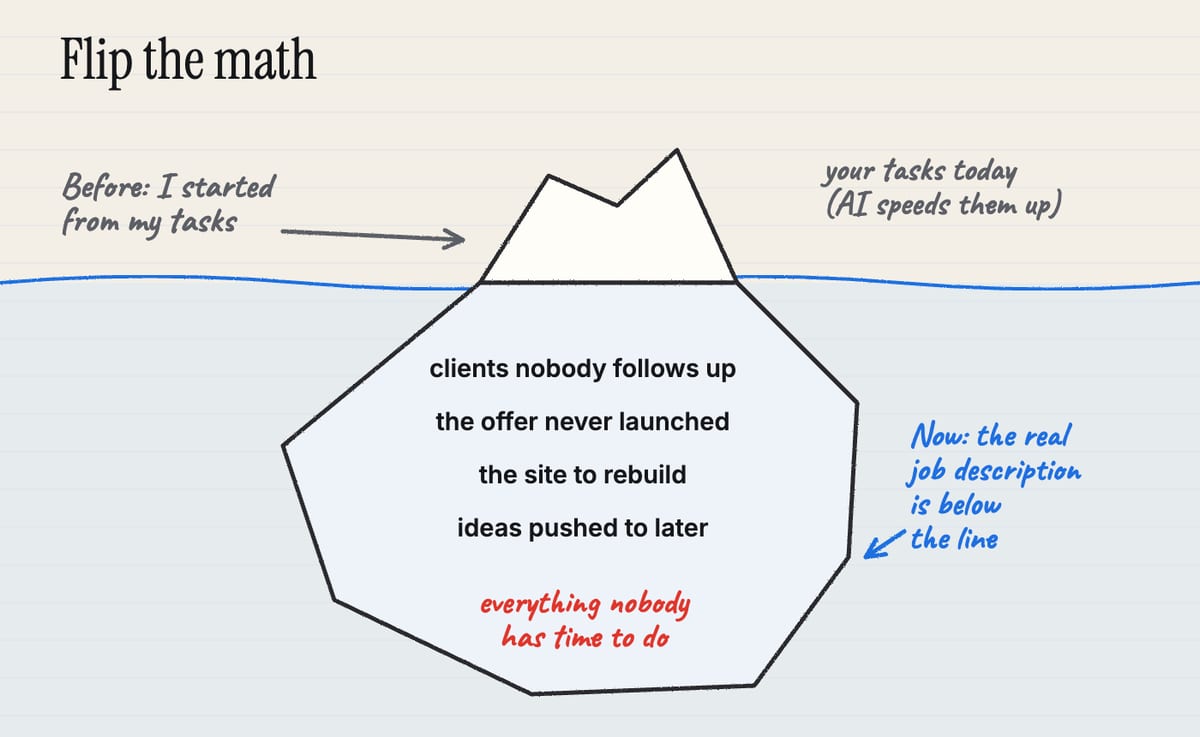
To do: the flipped-math exercise. It takes twenty minutes, and I recommend it even if you're not hiring right now.
- List everything that never gets done for lack of time. The clients nobody follows up with, the website nobody rebuilds, the offer you never launched, the ideas you keep pushing back.
- For each line, write down what it would bring in if it got done. In money, in clients, in time saved.
- Add today's tasks that AI speeds up. They'll only take a small part of the week now.
That list is the real job description.
And if you're looking for a job, do the same exercise from the point of view of the company you want to join. What they never have time to do is exactly what you can offer to take on.
These people are rare
That's the truth today.
Someone who knows their job well and is completely at ease with AI is rare.
Which is why I'll say it plainly: I'd rather pay that person twice as much as someone who isn't.
Because, from what I see, they produce a lot more than twice as much.
For some roles, it has even become very hard for me to justify a hire any other way. Paying someone for a 35-hour week to do work that a person fluent with AI would get done in a few hours is mostly paying for time.
I want to be honest about one thing.
Serious studies measure smaller gains than what I'm describing. The best known was run in 2023 by Harvard researchers with the consulting firm BCG, on 758 consultants. On tasks AI handled well, those using it worked 25% faster and their work was rated 40% better. But on a task AI handled badly, those who trusted it got it wrong more often than those working without it.
The researchers call this the "jagged frontier": AI is excellent at some tasks and bad at others, sometimes very similar ones, and nothing warns you when you cross from one to the other.
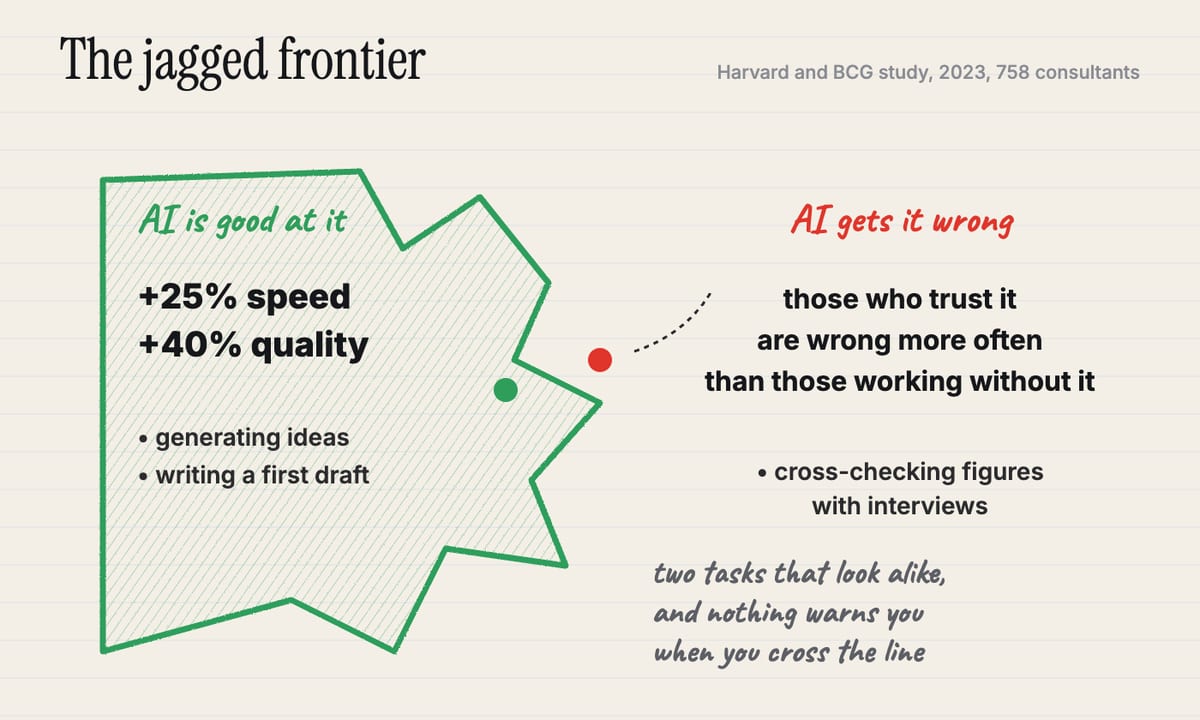
These studies mostly look at people discovering the tool. What I see in people who have truly reorganized the way they work is a lot more. But that's my experience, not a measurement.
And the second part of the study says something essential.
Working with AI, or letting AI work
There's a big difference between the two.
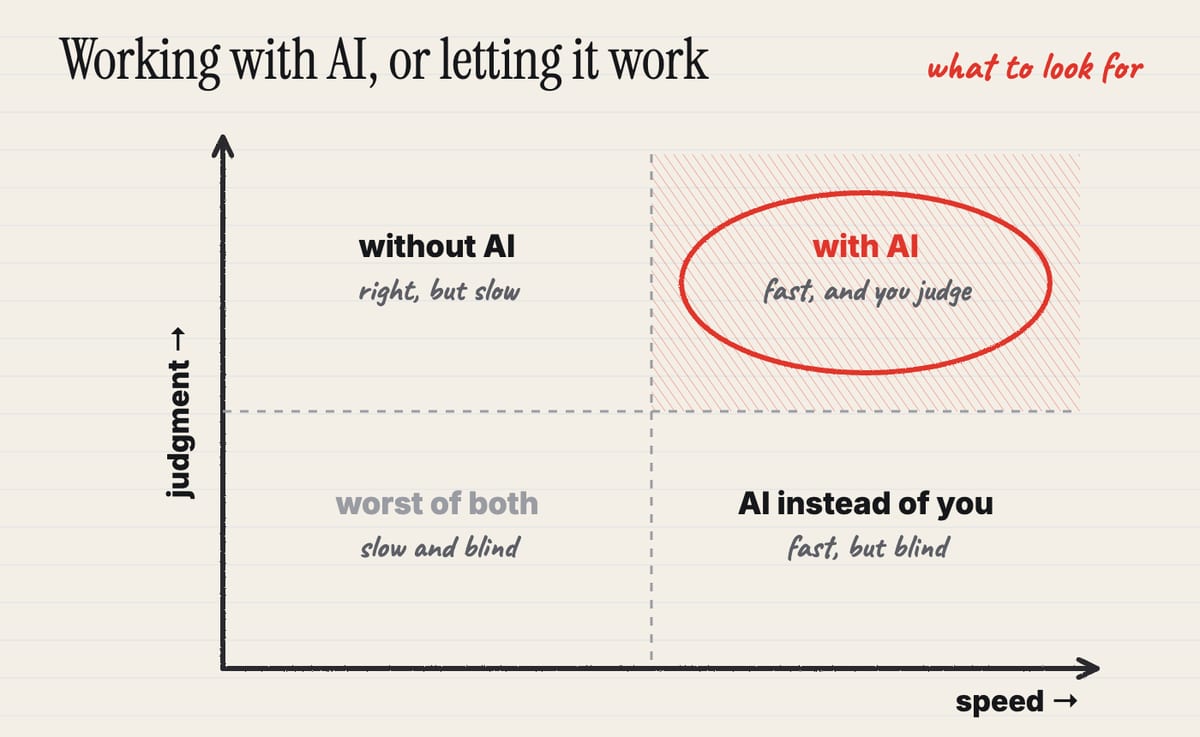
Letting AI work means handing it the task and taking whatever comes out. It's fast, but you stop seeing the mistakes. That's exactly what the study shows: those who trusted it blindly got it wrong more often.
Working with AI is something else. You stay in the loop. You give it direction, you review, you fix, you decide. It moves fast, and you keep the judgment.
To be honest, that's how I work today.
I don't have automations doing everything without me. And I don't do everything alone either.
I've reached the point where I work with AI as a true partner, and I see the difference every day.
That balance is very hard to find. And it's exactly what I look for when I hire.
To do: the three-ways test. Take your five main tasks. For each one, ask yourself honestly where you stand today: without AI, AI instead of you, or with AI.
- If you're "without AI" on a task AI does well, that's time you're leaving on the table.
- If it's "AI instead of you" on a task you no longer review, that's a risk. One day, a mistake will slip through.
The goal is to move as many tasks as possible into the "with AI" box. Start with just one this week.
If you're hiring
First, you need to be comfortable with AI yourself.
That's what gives you judgment. If you don't know what AI does well in a job, and what it does badly, you can't know what's left to do, or recognize someone who does it well.
Help the people who hire with you understand these subtleties.
That's what I'm working on right now: making sure whoever handles hiring understands how each job is changing with AI. That understanding is what lets you recognize someone who truly works with it.
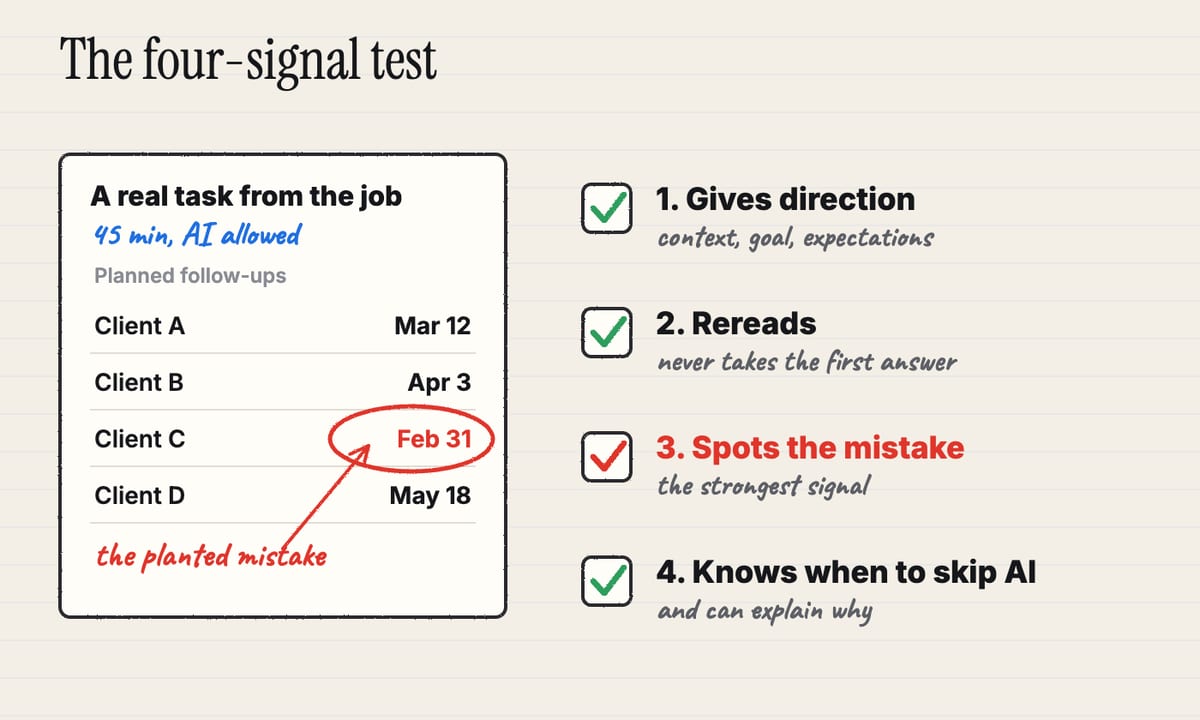
Run the four-signal test.
Give them a real task from the job, for 45 minutes, with AI allowed. And deliberately slip a mistake into what you hand them: a wrong number, a date that doesn't add up, a contradictory piece of information.
Then watch for four things:
- They give direction before asking. They explain the context, the goal, and what they expect to the AI, instead of pasting the brief as is.
- They review. They don't take the first answer; they question it and fix it.
- They catch the mistake you planted. It's the strongest signal, the sign of someone who keeps their judgment.
- They know when not to use AI. On part of the task, they choose to do it themselves, and they can explain why.
Then ask these three questions:
- "Show me the last thing you did with AI. What did you fix after it?"
- "Which task do you refuse to hand over to it, and why?"
- "How do you check that a result is right?"
Someone who really works with AI answers right away, with specific examples. Others stay vague.
A year or two ago, you could still hire someone who didn't use AI. Today, for many roles, that's already a real risk.
If you're looking for a job
I'll be direct: you can no longer afford not to be comfortable with AI.
But the good news is that if you are, and you know your job well, you're one of the profiles everyone is looking for, and they're rare.
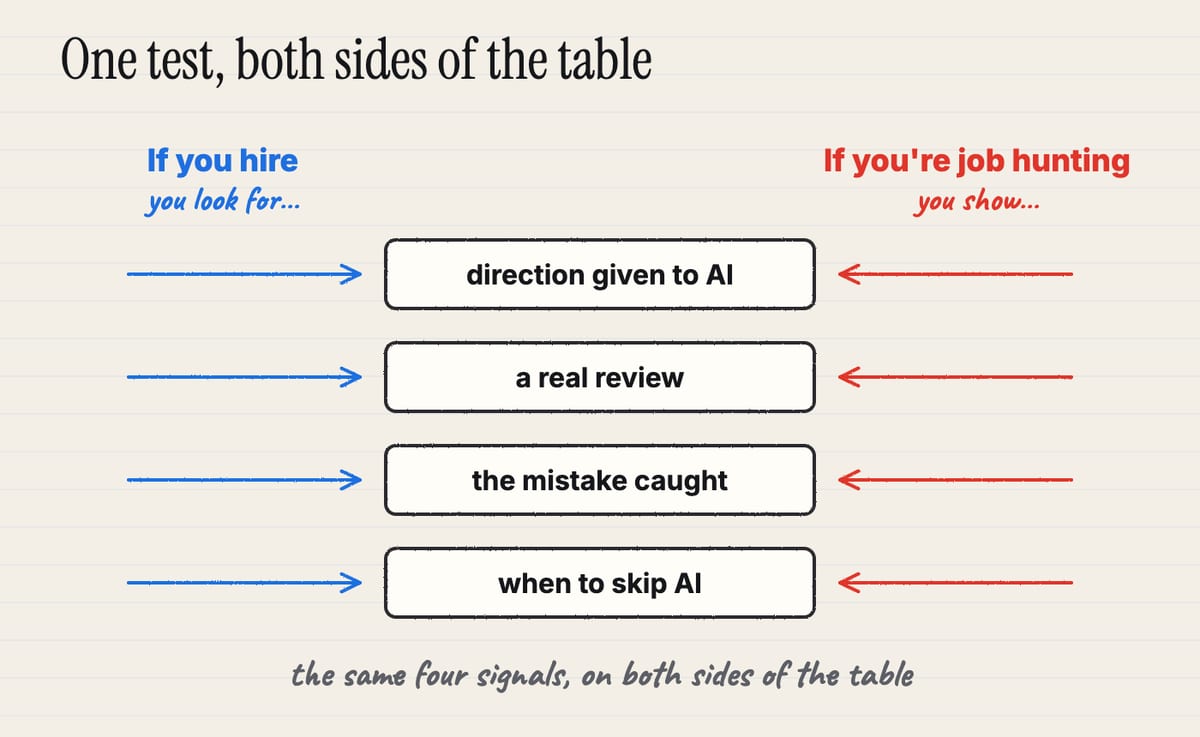
What the recruiter looks for is exactly what you need to be able to show. Go back over the four signals above, and practice each one.
Take one part of your job, and do it with AI every day for four weeks. Not once to try it out. Every day, on a real task.
And keep a proof log. One line per task, with four columns:
- the task;
- how long it used to take, and how long it takes now;
- what AI got wrong;
- what you fixed.
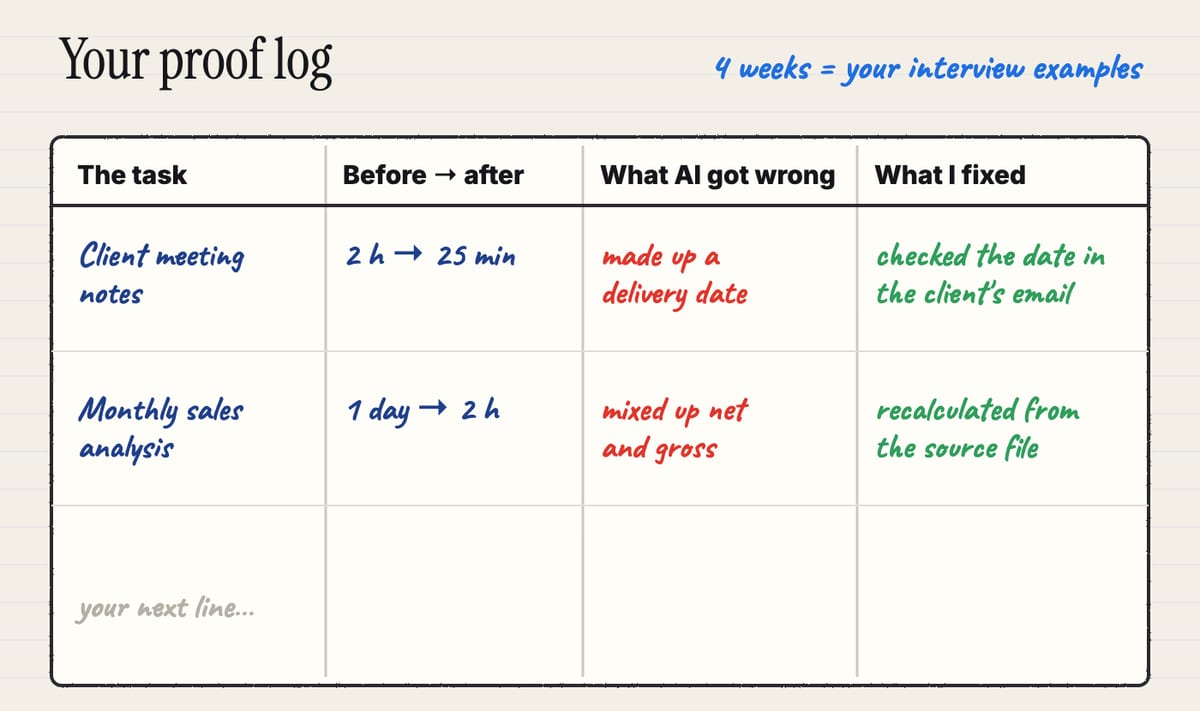
After four weeks, you'll have specific examples to give in interviews. And when someone asks you the three questions above, you'll have real answers.
Keep this: the prompt to get started
Whether you're hiring or job hunting, the starting point is the same: knowing what AI concretely changes in a given job.
Copy this prompt into your AI, replacing what's in brackets:
<context>
I am [your job, or the role you want to hire for]. I want to understand concretely what AI changes in this job, so I can work with it while staying the one who judges, rather than letting it do the work for me.
</context>

<instructions>
Before answering, ask me 3 questions, one at a time, about what I actually do day to day. Wait for my answer before each next question.

Then sort the tasks in this job into three groups:
1. What AI does well, and that I should learn to hand over to it.
2. What AI does fast but badly without someone reviewing: for each task, say what needs checking.
3. What AI can't do, and which becomes the real value of the job.

If you're not sure about a task, write "to check" rather than guessing.
</instructions>

<format>
One table per group, with 5 tasks max per group. Then a 4-week plan to become truly effective on groups 1 and 2, one task per week.
</format>
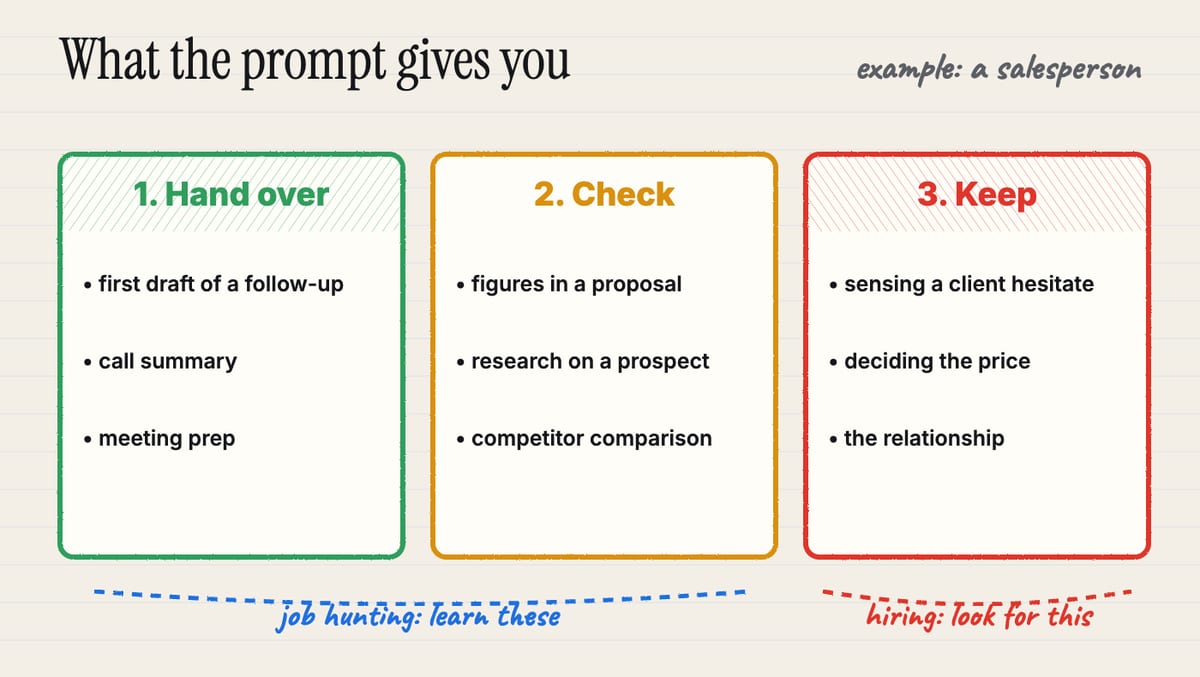
If you're hiring, group 3 tells you what to look for in interviews.
If you're job hunting, groups 1 and 2 tell you what to learn this week, and so what to write in your proof log.
Sunday, in the Report
I go much deeper on this topic in Sunday's Ergon Report, for professionals and entrepreneurs.
With clear steps, for people who hire and people who are job hunting, that you can start applying right away. If you're interested, you can get it here.
If you'd like us to talk about hiring more often (how to train yourself to get hired, or how to hire well in the age of AI), subscribe to the Brief (it's free) and reply "HR" to any of our emails.
AI doesn't replace good people.
It makes the ones who know how to work with it far more valuable.
Talk soon,
Salim
PS: With Othmane, a platform built for Ergon is coming soon, and I'll tell you more about it. A full version will be free for Ergon founding members, DiraIA members, and Ergon Report subscribers.
Get The Ergon Brief every week