
Your AI is spying on you
What really happens to your data
It's one of the questions you ask me most often.
Not "what's the best prompt?"
Not "how do I use AI to save time?"
But:
"Can I trust AI with my data?"
And it's always the same people asking. Lawyers. People in finance. Doctors. HR. Everyone who handles sensitive data day in, day out.
And they're right to ask.
Because when you type a client contract into ChatGPT, when you paste a balance sheet into Claude, when you have Gemini summarize a medical file… that data goes somewhere.
And nobody really explains to you what that "somewhere" is.
So let me.
But before that, if protecting your data is something you care about, good news: it's also the mission of our Geneva-based sponsor:
Free email without sacrificing your privacy
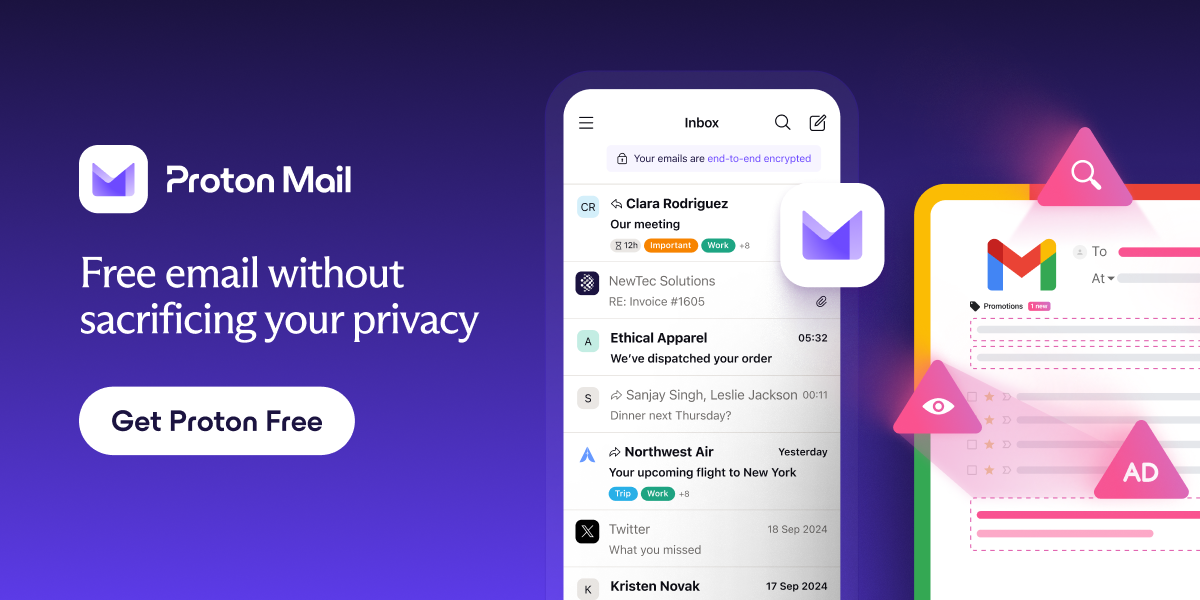
Gmail tracks you. Proton doesn’t. Get private email that puts your data, and your privacy, first.
OK, back to our models. Let me explain how all of this works.
In the AI world today, there are two big families of models.
Proprietary models: ChatGPT, Claude, Gemini. These are the most powerful. The smartest. Billions of dollars of research behind them. The problem? Your data passes through their servers. Often in the United States.
By the way, did you see what happened two weeks ago?
Anthropic (the company behind Claude) refused to let the US military use its AI for mass surveillance of citizens or in autonomous weapons systems. A few hours later, OpenAI signed the contract with the Pentagon…
The result: ChatGPT uninstalls jumped 295% in a single day. 2.5 million people left the platform.
That shows you how central the question of security and ethics has become, even for the general public.
Open source models: here, the code is open. Anyone can download it and run it on their own servers.
The key phrase is "their own servers." Because if the model runs on your own machines, your data never leaves. It stays with you. Full stop.
That's the real promise of open source when it comes to security.
Now, within the open source world, there's a second debate nobody explains to you.
There are European models (like Mistral). And Asian models (like Qwen, DeepSeek…).
The reality, frustrating as it is: Asian models are significantly better than European ones today. We're not talking about a small gap. More importantly, the Asian ones rival ChatGPT on many tasks. The European ones, not yet.
The catch is that Asian models can carry certain biases tied to their training data.
(Fun fact: those biases aren't necessarily "Asian." English makes up ~45% of the training data for most models. The result: even a Chinese model carries a Western bias.)
So the dilemma is:
→ A "neutral" European model that performs noticeably worse?
→ Or a powerful Asian model, with biases to correct?
And that's where the security question gets interesting. Because in reality, when we talk about "AI security", we're mixing up two things: the confidentiality of your data (where it goes, who uses it) and the reliability of the model (its biases, its mistakes, its values).
Both matter. Especially if you're a lawyer or in finance.
So what options do we have today?
Option 1: Use proprietary models (ChatGPT, Claude…) and accept that your data passes through third-party servers. For many uses, that's fine. And the quality is unbeatable.
Option 2: Host an open source model yourself. Maximum security, but you need the infrastructure, the technical skills, and you often end up with weaker models.
Option 3: Go through a trusted third party that runs the best open source models on its own servers, without storing your data.
It's this third path that I find most interesting for most people.
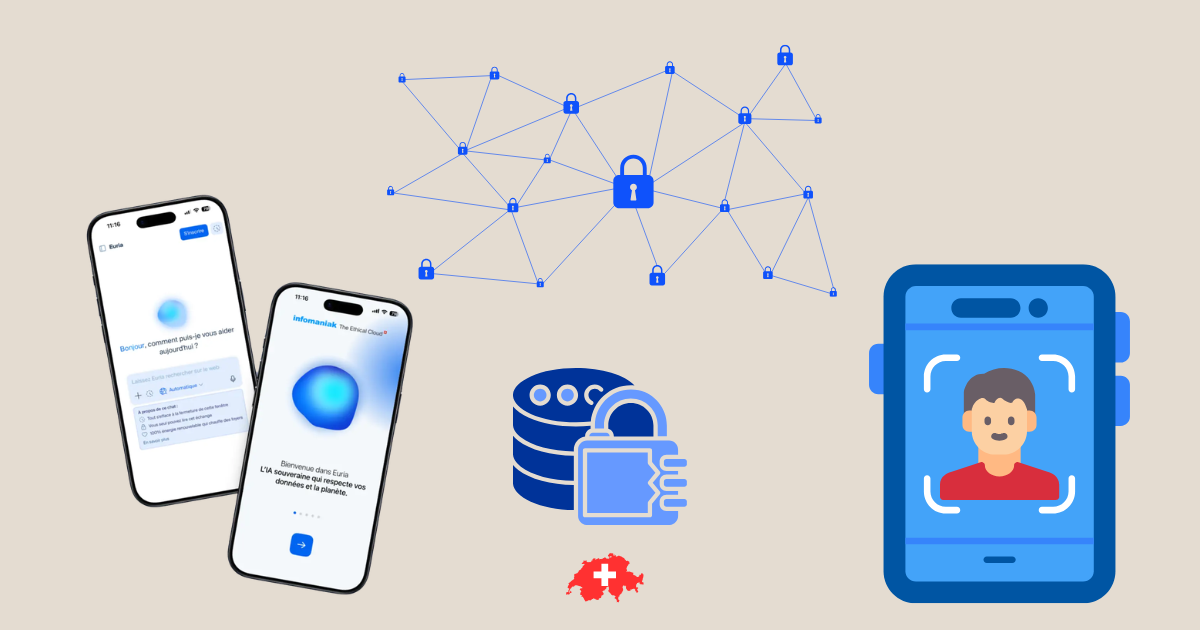
And in Geneva, we're lucky to have one of the biggest Swiss tech companies doing exactly that: Infomaniak. I recently had the chance to talk with their team, and here's what I learned about their AI, Euria.
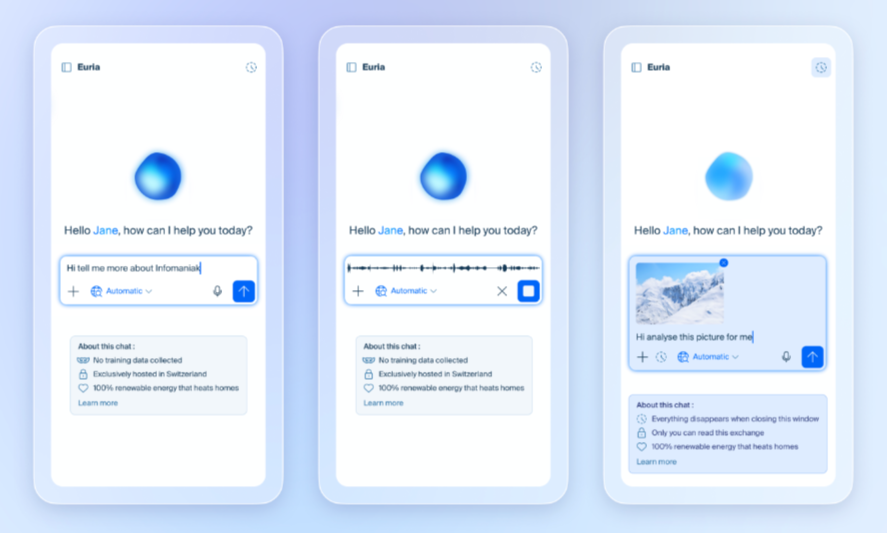
Their approach: they use the best open source models available (including Asian ones, like Qwen), they correct the biases themselves, and above all, your data is neither stored nor used for training. Nothing.
Everything runs on servers in Switzerland.
They hope European models like Apertus (Swiss) or Mistral will one day be up to par. But in the meantime, rather than offering you a mediocre model in the name of "100% European", they made the pragmatic choice:
the best possible model, with maximum security.
And I respect that. Because let's be frank: a "secure" AI that nobody uses because it's ten times worse than ChatGPT… isn't securing anything at all.
OK, now I'm going to be honest with you.
If your data isn't confidential (if you're writing a LinkedIn post, brainstorming ideas, looking for inspiration, working on a personal project…), between us, just use the best tools. Period. Don't overcomplicate things.
But if you handle client data, contracts, balance sheets, medical files… that's a different story.
What I personally recommend is a mix:
→ Claude for raw power. When you need the best model, for non-sensitive tasks, it's what I use every day.
→ Euria (by Infomaniak) for anything involving sensitive data: transcription, meeting minutes, confidential emails, contextual research. Your data stays in Switzerland and is never stored or used. Full stop.
Security isn't a binary choice. It's not "everything locked down" or "nothing at all." It's knowing when to protect your data and when to use maximum power without overthinking it.
And now, you know how to do that.
Talk soon,
Salim from GenevIA
P.S. How much does AI security worry you?
Get The Ergon Brief every week