
Why your AI results are mediocre
The gap between what you think and what you type
Last year, I asked Claude to write me an email.
The result? Flat. Generic.
I sighed. I tried again. "No, that's not it. I want something punchier, more personal." Second attempt. Still meh. Third attempt. Same.
And then I did something different.
Instead of firing back two words, I took 30 minutes to really explain what I wanted. What I wanted the reader to feel.
First attempt: perfect.
That's when I realized something that changed the way I use AI for good.
…But let's be honest. 30 minutes to write instructions? At that point, I might as well write the email myself.
I told this story to a friend in Boston. He laughed in my face.
"Salim, you spent 30 minutes typing your prompt? I get it done in 30 seconds."
I didn't get it right away. But when he showed me his screen, it clicked.
We'll come back to that. First, let me explain why everything starts with the prompt.
The problem isn't the AI. It's what we feed it.
What you give the AI is called a prompt. It's the starting instruction. And most people (me included, for a long time) underestimate how much that prompt changes EVERYTHING.
The more precise you are, the more precise the AI is.
In practice, a good prompt includes:
→ Context: who you are, who you're talking to
→ A clear format: length, tone, structure
→ Examples: what you want AND what you don't
→ Your constraints: the style, the words to avoid, the details that matter
The more you explain, the less you have to retry.
Now, the thing nobody tells you.
Everything I just explained, I already knew. For months.
And yet my prompts were still too short. Too vague. Why?
Because I don't know about you… but I type infinitely slower than I think.
My brain runs at 120 mph. My fingers, at 20.
So it was the same story every time: I'd start detailing my prompt, add some context, some examples… and after two minutes, I'd think "eh, that'll do".
Absurd, right?
And that's where my friend in Boston comes in.
The tool he showed me that day? Wispr Flow.
Smart dictation. You talk, and it turns your voice into clean, structured text: straight into ChatGPT, Claude, your email, anywhere.
And it's CRAZY how accurate it is.
The price of the version I use every day: FREE
(It works perfectly in French too, and in plenty of other languages.)
Better prompts. Better AI output.
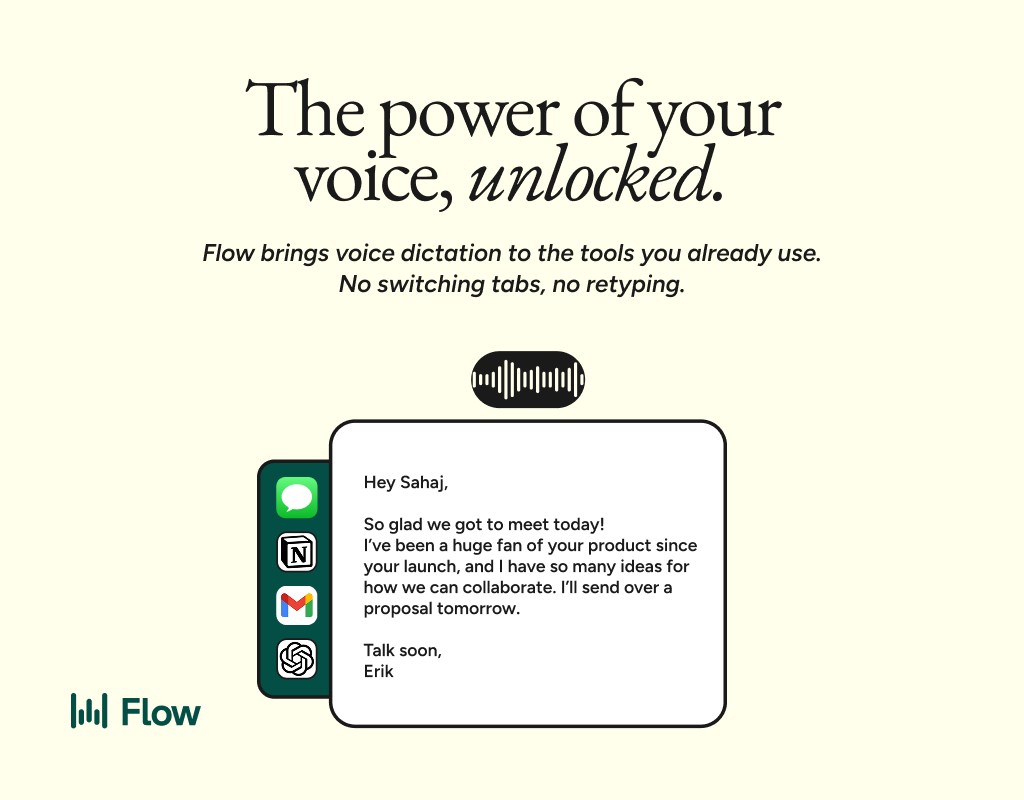
AI gets smarter when your input is complete. Wispr Flow helps you think out loud and capture full context by voice, then turns that speech into a clean, structured prompt you can paste into ChatGPT, Claude, or any assistant. No more chopping up thoughts into typed paragraphs. Preserve constraints, examples, edge cases, and tone by speaking them once. The result is faster iteration, more precise outputs, and less time re-prompting. Try Wispr Flow for AI or see a 30-second demo.
Now, instead of painfully typing for 5 minutes… I talk for 30 seconds. I unload everything naturally, as if I were explaining it to a friend. The context, the tone, the examples, the exceptions.
The result: prompts that are 10x more detailed. AI answers that land on the first try. And I'm only using the free version.
The real takeaway
Next time AI gives you a mediocre result, don't blame it. Ask yourself one question:
"Did I really take the time to explain what I wanted?"
If the answer is no (and let's be honest, it's almost always no), then you have your answer.
Whether it's with Wispr or some other way, find your own way to close the gap between what's in your head and what you write.
Your AI results will be transformed.
Talk soon,
Salim from GenevIA, in Geneva
Get The Ergon Brief every week