
What Stanford just confirmed about junior employees
A passage I can't keep to myself

Hello,
I just finished writing issue 2 of The Ergon Report, and there's one passage I can't keep for premium readers only. It's the one that changed my mind the most while I was writing it. So I figured I'd share it with you here, for free, as is.
N.B. The Ergon Report is the new premium newsletter, spun off from GenevIA, for leaders who don't want to sit out AI and want to make the right calls over the next eighteen months. One thesis per issue. Concrete cases. A lens to see clearly. A usable tool every week.
Excerpt: The E****rgon Report #2, The senior factory
A CEO told me recently that he'd just noticed something strange. His company hadn't hired a single junior in fifteen months. Nobody had made that decision. It had just happened.
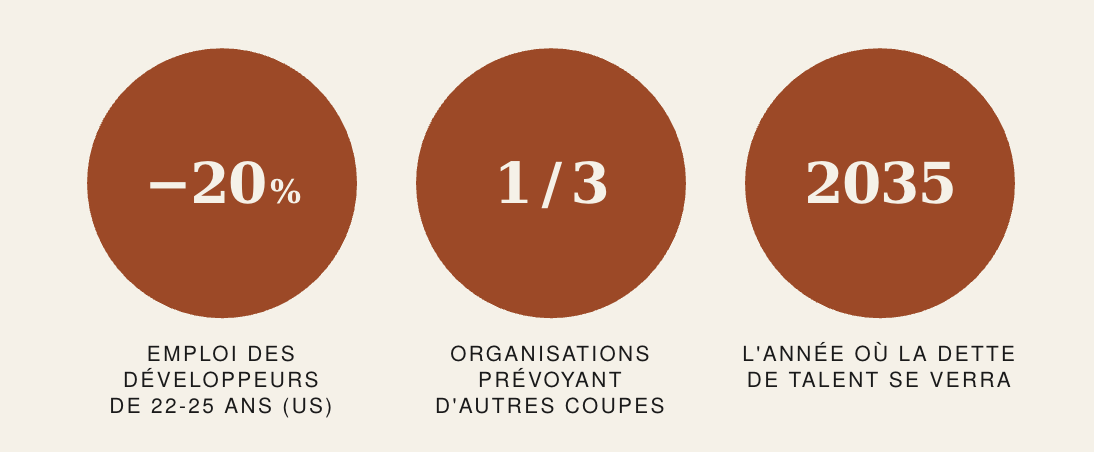
On April 13, the Stanford AI Index 2026 came out. One number jumped off the page. Employment of US software developers aged 22 to 25 had dropped by nearly 20% since late 2022. Over the same period, headcount among their older colleagues kept climbing. Same pattern in customer service. And according to McKinsey, a third of organizations are planning further cuts within the year.
The number is striking. What people say about it isn't. Everywhere, the same reading: AI is replacing juniors, we debate the ethics, we move on. That reading is partly true. But it only tells half the story. And what it leaves in the dark is going to be expensive.
What Stanford is seeing isn't the main effect of AI on jobs. It's the visible part of a deeper shift, and only the first level has given way so far. The second level is silent. Yet it's the one that will decide which companies make it through the decade.
The question isn't whether juniors are disappearing. It's this: who is going to make the seniors of 2035, and how?
What juniors were really doing
To understand what's happening, you first have to look at juniors differently. For a long time we saw them as cost centers. They produced little, cost money anyway, and it took years before they paid off. That view isn't wrong. It's just incomplete.
A junior produced little, true. But in the meantime, they were doing something far more important: they were being made.
A senior breaks the problem down. The technical, repetitive pieces get handed to a junior. And while the junior works through them, something happens quietly. No classes, no training, but they see a hundred cases go by. They start to sense things. They develop a nose for it. And that nose can't be passed on in writing.
This is what the philosopher Michael Polanyi called tacit knowledge back in the sixties. His line became famous: we can know more than we can tell.
In August 2025, three Stanford researchers backed up the intuition with numbers. Analyzing payroll data for millions of American workers, Brynjolfsson, Chandar and Chen showed that AI mostly replaces codified knowledge, the kind you learn in school. And that it complements tacit knowledge, the kind that comes from experience. Polanyi, sixty years later, confirmed by payroll records.
That's the problem. By automating juniors' repetitive tasks, we didn't just cut a cost line. Without realizing it, we cut one of the best tools we had for training tomorrow's seniors.
Juniors were never just a cost line. They were also our investment, disguised as an expense.
End of excerpt
In the rest of the issue (out Sunday), I cover
-
four archetypes to map your teams (the Unicorn, the Accelerated, the Senior without AI, the Blind Producer),
-
what Switzerland held on to that the Western world is about to rediscover,
-
and the one strategic choice that matters for the next three years.
The Ergon Report is a weekly read for leaders who want to understand AI deeply enough to make the right calls. One thesis per issue. Concrete cases. A lens to see clearly. A usable tool.
If you want this analysis landing in your inbox every week, and you don't want to miss the next time Stanford, PwC or McKinsey drops a number that changes how we read the decade, here's the link to subscribe:
Quick note: the launch founder rate is still available this week. If you're interested, now's the time to grab it.
Talk soon,
Salim
Get The Ergon Brief every week