
The copy-paste prompt framework
The end of "You are an expert in..."

Today, a how-to: how to structure a good prompt in 2026, step by step.
Because yes, knowing how to write a prompt is still useful, and most people still get it wrong. But it's no longer the most important thing. So before the tutorial, I want to start with what is.
Let's start with a trick you probably picked up, like everyone else.
Give the model a role. "You are an excellent engineer." "Act as a senior consultant with twenty years of experience." It seemed serious, almost magical.
In 2026, it barely does anything. Recent models read your intent without needing a costume, and the "prompt engineer" job, billed two years ago as the skill of the future, has largely disappeared.
That detail reveals a much deeper shift.
The prompt was never the real problem.
For three years, we turned it into a discipline. Tutorials, courses, two-page "mega-prompts." But models have become so capable that prompting, as a craft, has become easy. Intelligence is now almost infinite and almost free.
And when intelligence becomes infinite, the difficulty moves: it leaves the answer and settles into the question. The real bottleneck is no longer phrasing a request. It's knowing what to ask for.
An example I know well: writing.
Claude writes beautifully, in whatever style you want. So that's no longer where the difficulty lies. It's in everything that comes before the prompt:
-
Which style, exactly? Do you even know what it's called?
-
Which register, which tone, how formal?
-
And would you even recognize it when you saw it?
Wittgenstein said that the limits of our language are the limits of our world. Today, you could say: the limits of your taste are the limits of your AI. You can't ask for what you can't picture yourself.
Another case: "Write me a LinkedIn post that works."
That doesn't work. It's a wish, not a prompt.
What works is knowing the field well enough to name what makes the difference: a hook built a certain way, a conversational rhythm, an open loop from the very first line.
A good post isn't produced by a good prompt, but by someone who already knows what a good post looks like.
That's also why a prompt designed by someone who truly masters their field, or a real prompt library, is worth far more than people think. What you get isn't a phrasing. It's the knowledge of someone who already knows what to ask for.
That's the point I wanted to make. Now, the practice.
Structure hasn't disappeared, though. Knowing what to ask for is 80% of the work, and the hardest part. Writing it down cleanly is the remaining 20%: easy, but it's what keeps a perfectly clear intention from getting lost. So here's the anatomy of a good prompt in 2026.
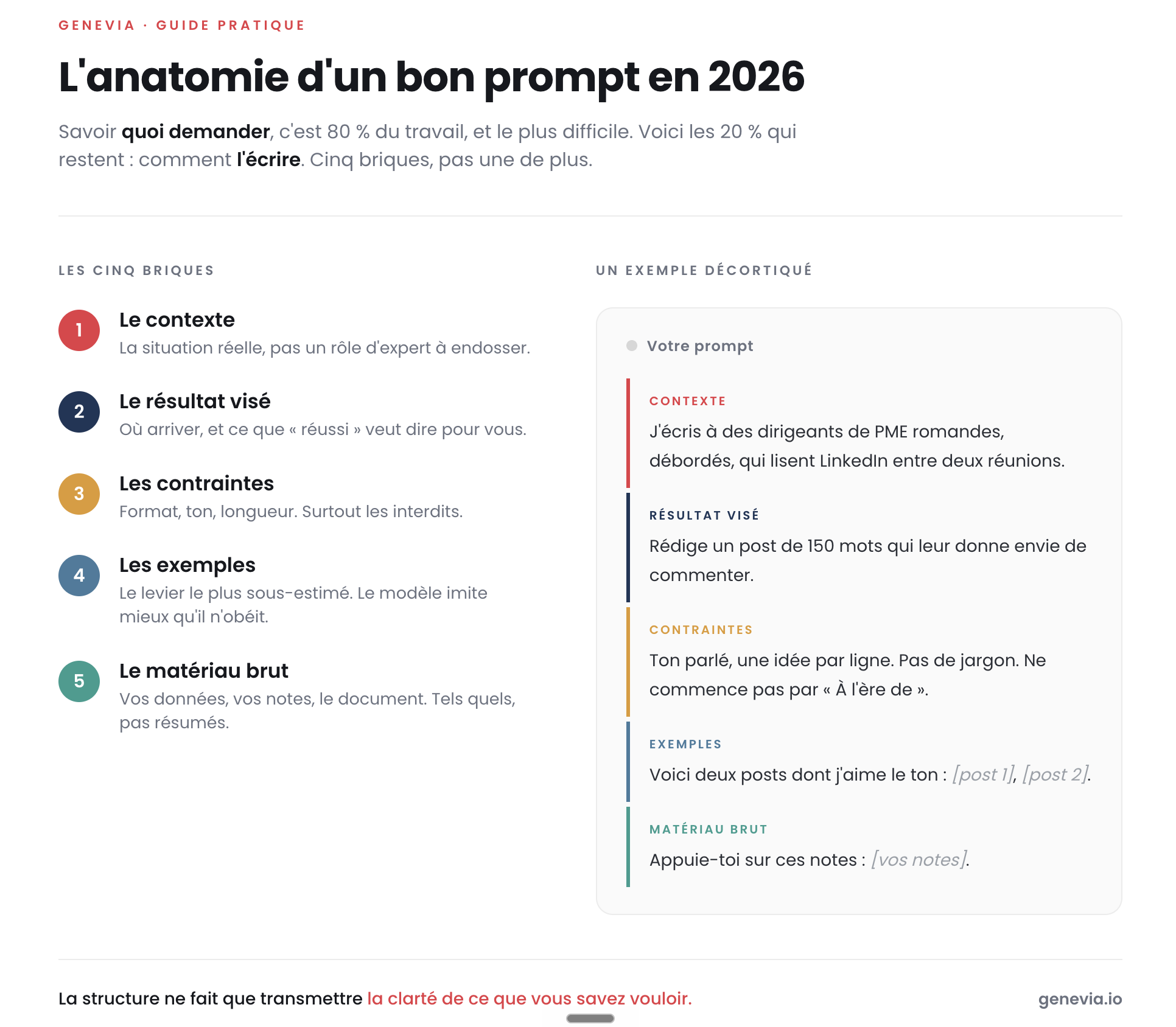
The five building blocks
1. Context, not a role. Describe the real situation instead of dressing the model up as an expert.
2. The intended result. Say where you want to end up, and what "success" means to you. "A good text" means nothing.
3. Constraints. Format, tone, length, and above all what's off-limits: "no jargon," "don't open with In today's fast-paced world."
4. Examples. Two or three samples of what you like are worth more than ten lines of instructions. The model imitates better than it obeys.
5. The raw material. Paste your data, your notes, the document, as is, without summarizing them.
And three old habits to uninstall, before / after:
-
"You are an expert in..." → give the real context of the task instead.
-
"Think step by step" → drop it, reasoning models already do it on their own.
-
A sprawling prompt that dictates every step → set the course, don't call every oar stroke.
One last habit: keep it short.
The best prompt isn't the longest one, it's the clearest one. And the first try is rarely the right one. You refine, you run it again, that's normal.
And even with this anatomy in mind and a perfectly clear intention, a prompt borrowed from someone else always needs to be adapted to your own. A prompt, by nature, doesn't know you: not your context, not your voice, not what you call "success."
In the end, it all comes down to one sentence.
❝
The quality of what you get reflects how clearly you know what you want.
Structure just carries that clarity across without distorting it.
Talk soon,
P.P.S. If you want to go further on how AI is redefining companies and work, The Ergon Report is GenevIA's private report, designed for executives and professionals who want to make the right decisions over the next 6, 12 and 18 months. It's right here.
Get The Ergon Brief every week