
The asset AI can't replace
The most powerful tool of this decade can help you build the one thing it will never replace.

What I'm sharing today is, in my view, what will make the biggest difference for companies and careers in the years ahead.
It's a topic that has obsessed me for years, and it would be a real shame not to share it as widely as possible.
And since huge news in the tech world put this topic back at the center of everything this week, I'm taking the opportunity.
So here's a key excerpt from issue 3 of The Ergon Report, out Sunday at 7 a.m.
N.B. The E****rgon Report is the premium newsletter, spun off from GenevIA, for leaders and professionals who don't want to sit out AI and want to make the right calls over the next 18 months. One thesis per issue. Concrete cases. A lens to see clearly and go further. A usable tool (ready-to-use prompts, Claude Skills, cheatsheets…) every week.
Excerpt: The E****rgon Report #3, The asset AI can't replace
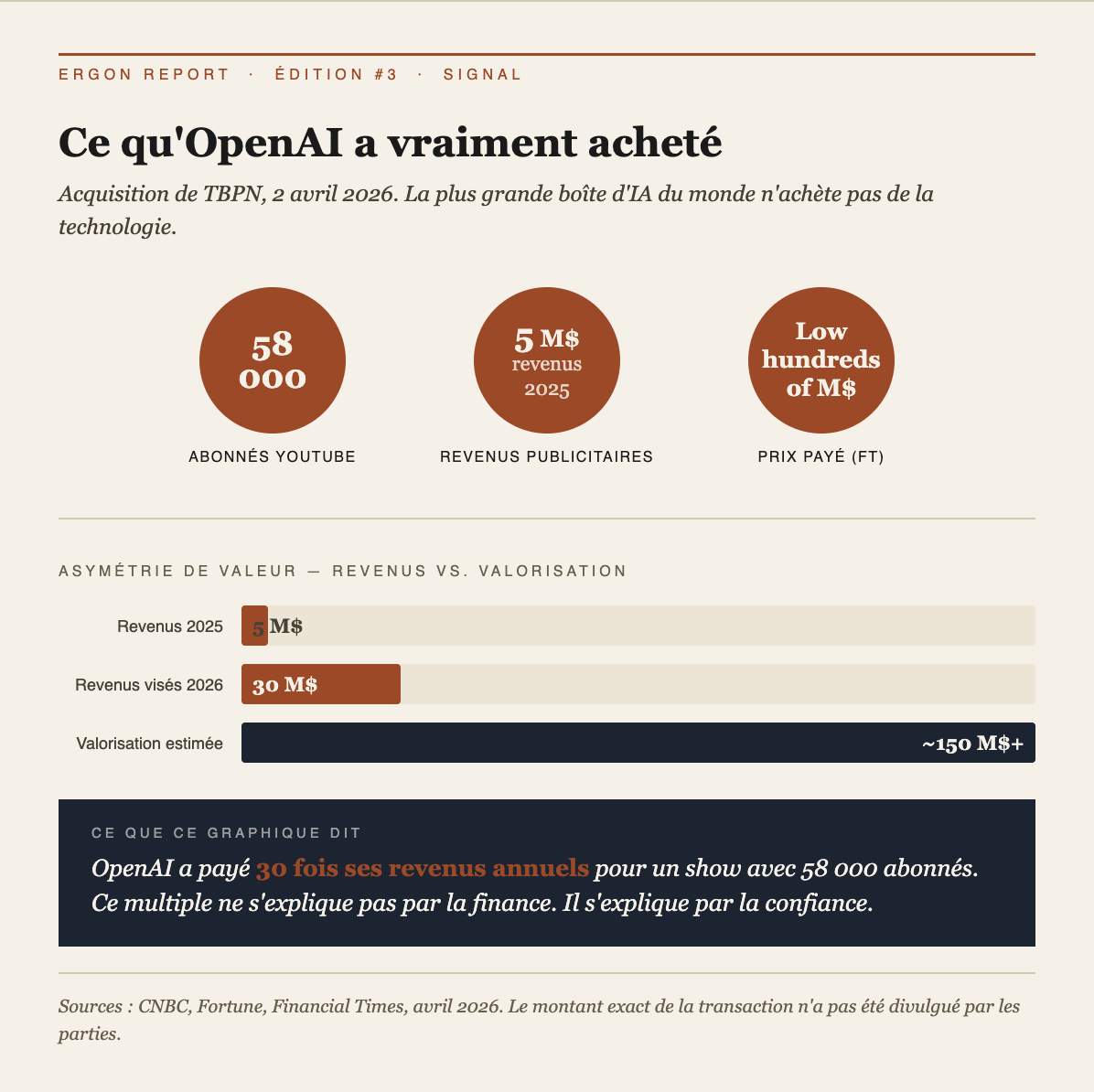
On April 2, OpenAI bought a YouTube talk show. 58,000 subscribers. $5 million in revenue last year. Price paid: several hundred million dollars.
The tech world's reaction: "Wait, what?"
Mine: it's the clearest signal I've seen in a long time. The company building the most powerful tools in the world isn't buying a model, a dataset, or a tech startup. It's buying 58,000 people who trust it.
In 2000, having a website set you apart. In 2010, not having one knocked you out. AI is going to travel the same road, three to five times faster. That's no reason not to do it now. It's a reason not to believe that's where the lasting advantage is won.
Because while everyone is optimizing their tools, something else is becoming scarce.
In a few years, your doctor won't be judged on what they know. They'll be judged on how much you trust them to choose their tools. The same way you already trust your pharmacist, not to make the drugs, but to know which one to give you.
I'm living this right now, at two different scales.
My newsletter, which you probably read every week (GenevIA), brings together 17,500+ French-speaking professionals around one specific topic. It's not a contact list. A list can be bought. Trust like this is built week after week, and it can't be transferred. If you've been reading me for a few months, you're living proof of what this issue explains.
My startup in the dental sector made the same bet from day one. Before having a perfect product, we built the largest community of professionals in the field around AI, through a dedicated media outlet.
That choice changed everything.
Today, when we announce a new feature, requests come in within hours, from professionals we've never reached out to, in countries where we don't have a sales presence yet. No competitor showing up with a better product can buy that. It was built first.
That's the asset AI can't create for you.
And this is where the paradox gets dizzying:
AI can help you build this exact asset faster than any generation before you.
❝
The most powerful tool of this decade can be put to work building the one thing it will never replace.
So in the rest of this issue, we ask a single question:
in a world where technical skill becomes available to everyone, what still makes people choose someone, trust them, and give them their share of the market?
The answer changes how you hire, how you invest, and what you do with your own career. And for each case, we'll go through the concrete steps to act on it. And the decisions that follow have to be made now.
End of excerpt
In the rest of the issue (out Sunday at 7 a.m.), we cover:
-
how to identify, in your company and your profession, the people and assets that will hold up against commoditization, and the ones that won't,
-
a concrete example of how to start building (and recognizing) this kind of trust, with precise steps, whether you're a leader, an investor or a professional,
-
and how to use AI to build, faster, the one thing it will never replace.
And if you want this analysis, plus a concrete tool you can actually use (ready-to-use prompts, Claude Skills, cheatsheets…), landing in your inbox every week, and you don't want to miss the next time Stanford, PwC or McKinsey drops a number that changes how we read the decade, here's the link to subscribe:
That's all for today.
One IMPORTANT note: the launch founder rate ends tomorrow. If you're interested, now's the time to grab it.
Talk soon,
Salim
Get The Ergon Brief every week