
Klarna replaced 700 humans with AI. Then it backtracked.
You're probably about to make the same mistake.
This week, something made me sit up.
Klarna, the Swedish fintech valued at $19 billion, just admitted publicly that it got AI wrong. Between 2022 and 2024, they cut 700 customer service jobs and replaced them with AI. At first, the numbers were spectacular: 2.3 million conversations handled in a month, 75% of customer chats automated.
May 2025. Complete U-turn. Klarna is hiring humans again. CEO Siemiatkowski admits to Bloomberg: "We went too far. What you end up having is lower quality."
What broke down at Klarna, they couldn't put a name to. And they're not alone, by the way.
That's what this week's issue of The Ergon Report is about, and here's a key excerpt, free (the full report comes out Sunday at 7 a.m.).
If you lead, if you manage, if you make the call on investments or hiring, what follows isn't just interesting background. It's operational information. The kind that decides whether the choices you make in the next 6 months, and even more in the 18 after that, make you stronger or cost you dearly.
N.B. The E****rgon Report is the premium newsletter, spun off from GenevIA, for leaders and professionals who don't want to sit out AI and want to make the right calls over the next 18 months. One thesis per issue. Concrete cases. A lens to see clearly and go further. A usable tool (ready-to-use prompts, Claude Skills, cheatsheets…) every week.
Excerpt: The Ergon Report #4, The Irreducible
To understand what broke down at Klarna, you first need to understand what this machine we call an LLM (a language model, like ChatGPT) really is. Not roughly. Precisely. Because once you grasp the mechanism, you automatically understand what it can do. And what it can't.
Here's the truth, stripped of the marketing.
An LLM doesn't reason. It predicts. Word by word, fragment by fragment. At every step, it looks at what's been written so far and calculates, out of tens of thousands of possible words, which one is statistically most likely to come next. It picks that one. Then it does it again for the next word. And so on.
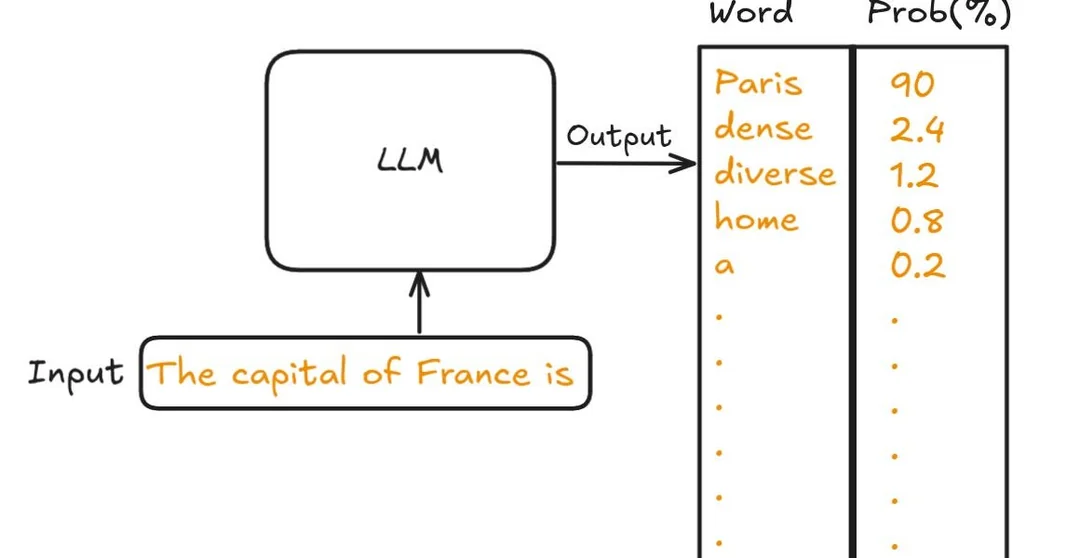
That's it. That's really all it is.
What makes this mechanism so impressive is the scale. A modern LLM like GPT-5 was trained on something like 30 trillion words.
Now brace yourself. A human child, to master their native language by around age 3, has heard roughly 45 million words in their life. That's the classic Hart and Risley study.
Do the math. 30 trillion divided by 45 million. The machine needs more than 600,000 times more data than a human brain to reach comparable language performance.
That comparison alone should make you rethink what you call "intelligence" when you talk about AI.
But back to it. Once you understand that the LLM predicts the most likely next word, you also understand why it's so strong at some things, and why there's one specific zone where it stalls.
It's strong at anything that forms predictable sequences. Drafting a standard contract. Translating. Coding a function. Rewording an email. Because those tasks are strings of words following patterns the machine saw millions of times during training.
And at things that require reasoning about something genuinely new?
That's where it gets tricky. Not because the machine "doesn't know", but because it doesn't have the mechanism for reasoning about the new. When it seems to manage, it's because it saw something close enough in its corpus. Or a combination of things close enough to piece together a plausible answer.
That nuance matters. Saying AI "isn't intelligent" is wrong. It's extraordinarily good at anything that resembles something it's seen before, even remotely.
And that covers more and more ground, because its corpus is huge. But there's one specific zone where the statistical mechanism stalls.
There you go. You have the mechanism. Now for the next step. And this is where it gets uncomfortable for a lot of professions.
The law of decomposition.
❝
Every complex task is a bundle of simple subtasks. The finer you slice, the more the machine can take on.
That's exactly how today's AI agents work: they break a complex problem down into a chain of simple subtasks, and run them in sequence.
Take a concrete task. A market analysis you pay a consulting firm CHF 30,000 for.
Break it down.
Step 1: gather the available data on the sector (industry reports, press releases, annual accounts).
Step 2: extract the relevant numbers and structure them.
Step 3: identify the main competitors and how they're positioned.
…And so on, all the way to the final step.
And if one of those steps still looks too complex to hand to an AI, all you have to do is break it down further.
Do that enough, going as deep as you need, and you always reach a level where every micro-task can be done by an AI today. That's the real law of decomposition: there's no floor below which the machine stalls, as long as you're willing to keep breaking things down.
If you take that sentence seriously, it changes how you look at your company. Your people. Your vendors. Your next investment decisions. Even what you do day to day.
But one question remains. If everything that can be sliced up can be done by a machine, what actually gets sliced up? What resists? And how do you operate between the two?
That's the real question of this issue of The Ergon Report.
In the rest of the issue (out Sunday at 7 a.m.), we cover:
-
the exact operational definition of what resists decomposition, why it's the only definition that holds up over five years, and how to spot it in any profession,
-
exactly why the Klarna project crashed on this precise point, and the test that would have caught it before a single franc was spent,
-
the decisions to rethink this week, over the next 6 months, and over the next 18 months if you take this framework seriously.
Break it down yourself, win back your time.
Understanding all this is a start. Applying it every day to your real work is something else. That's exactly the principle I'm building into ErgonOS, which launches soon.
ErgonOS is an app where, over a few weeks, you log the tasks you actually do at work. Not a theoretical audit. Your real tasks, in detail, as they actually exist.
Once it has enough material, ErgonOS analyzes the whole picture and tells you 3 things.
-
First, your ergon. Precisely. What you, in your role, are the only one able to do, and what justifies your value.
-
Next, the tasks that should be handed to AI right now, because they break down cleanly and eat up your precious time.
-
Finally, and this is probably the most important, the areas where you need to invest human effort to get stronger. Because those are precisely the areas AI won't take over in the years ahead.
ErgonOS is trained on every Ergon Report. You can talk to it like an advisor who has read each issue carefully. Every analysis it gives runs through the ergon / mechanical lens.
ErgonOS will be free for all Ergon Report subscribers who sign up before launch.
If you subscribe today, you keep the current price, and access to ErgonOS is included when it comes out. If you wait, ErgonOS will still be available, but on different terms.
If you want to be part of it from day one, now's the time:

That's all for today.
One IMPORTANT note: ErgonOS will be free for all Ergon Report subscribers who sign up before launch.
Talk soon,
Salim
Get The Ergon Brief every week