
How to survive AI's mass replacement of jobs
AI has made "good" free. Here's what matters now

If you spend a little too much time on social media, you probably have the feeling that every job is going to disappear by next Tuesday.
Take a breath.
No, jobs aren't going to vanish overnight. But something real is happening, and that something deserves better than panic or denial. It deserves to be understood, because once you understand it, it becomes an opportunity. For you too, starting this week.
Fair warning, though: what I'm about to tell you isn't necessarily what you want to hear. You've been told over and over that AI would do the work for you. That's half true. And it's precisely the other half that will make all the difference.
Here's the calm, honest version of what's changing.
But first, a quick word for some of you:
If you invest or run a company, and you have important decisions to make in the coming months, take a look at The Ergon Report, which you can now get free for 30 days.
Every week, you get a private analysis, deep but digestible, of what AI is really doing to companies, professions and markets, so you can make the right call on the decisions that will matter over the next ten months. Hundreds of Swiss and French-speaking leaders have already signed up (you'll find their reviews at the end).
If that sounds like you, join The Ergon Report here. The 30-day trial is no strings attached.
Yesterday's "good" is becoming free
Throughout our working lives, one unwritten rule has held firm: do "good" work, and you'll be rewarded. The person who spent a weekend polishing their application stood out. Doing "good" work took time, and that time showed in the result.
But let's be honest about what "good" has always meant.
"Good" was never a fixed bar. It's a position in a ranking. Working life is a hidden competition: you're told there's a bar to clear, but in reality, they take the best, wherever the bar happens to be.
I saw this firsthand at EPFL. Officially, you need a 4 out of 6 to pass an exam. In practice, grades are fitted to a bell curve: the grading scale shifts until the distribution has the desired shape. A 4 means nothing in absolute terms. It means "better than a certain fraction of the class". The bar follows the level of the group.
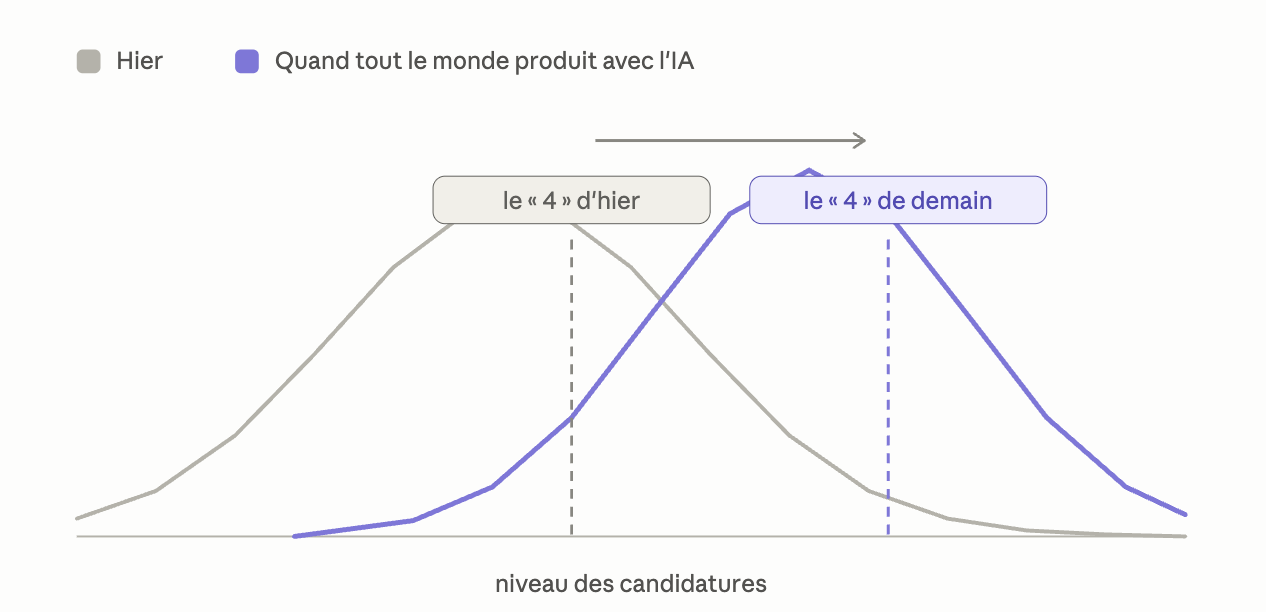
The working world operates exactly the same way, without ever saying so.
And in a competition, average is invisible. What impresses today will be the bare minimum tomorrow.
So AI doesn't wipe out your value. It raises the average level of the competition, and as a result it raises what "better" demands of you.
The good news: that extra step is within reach. It just means reinvesting the time AI saves you, wisely.
A question to ask yourself right now: the last time you produced something important (an application, a proposal, a presentation), what did you compare it to? Your own standard, or what everyone else in the pile was going to send?
The mistake: saving effort. The strategy: shifting it.
Let's take the most concrete example there is: looking for a job.
The natural reflex: "AI writes my resume in ten minutes, great, I've saved three hours." And those three hours evaporate.
The winning reflex: "AI writes my resume in ten minutes, great, I have three hours to invest where nobody else is investing them."
And there are plenty of options:
The marketing candidate who, instead of sending a cover letter, sends a one-page analysis of the company's online presence with three recommendations.
The accountant who prepares a mini audit of the processes they could improve.
The developer who builds, over a weekend, a small tool that solves a visible problem at the target company.
The project manager who documents a past project, numbers included, as a one-page case study.
A resume says "here's what I've done". A project says "here's what I'll do for you". The first is now mass-produced. The second remains rare, precisely because it can't be generated: it requires understanding the company, the role, the problem.
And note this: the same reasoning applies whether you're looking for a job, looking for clients as a freelancer, or simply want to stay valuable in your current role.
Try it this week (5 minutes): copy this prompt into your favorite AI:
"Here's the job (or the client) I'm going after: [describe it]. Here's my profile: [summarize it]. Answer in two parts. First, describe what 90% of candidates in my situation will send. Then, suggest five things none of them will do, each doable in under three hours, that would concretely demonstrate my value for this role."
The first part shows you the average. The second shows you where to put your effort.
The two skills to build starting now
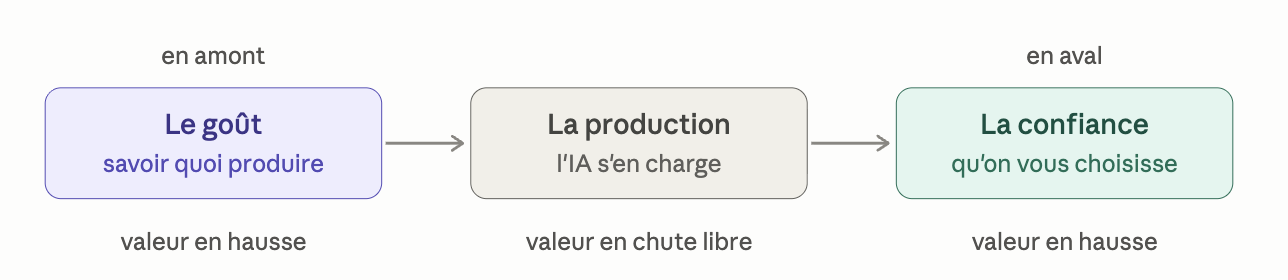
If producing has become easy, what's still hard? Two things. And those are the ones to develop deliberately.
1. Taste: knowing how to recognize "better"
When everyone can produce ten versions of a document, the decisive skill becomes the ability to spot which of the ten is the right one. To see what's missing. To sense what's generic and what's spot on.
It has a somewhat abstract name, taste, but you build it in a very concrete way: by exposing yourself to the best work in your field.
In practice: create a folder with the three best examples from your field you can find (the best report you've read, the best presentation, the best application). Then, for every important piece of work, give your document and one of those references to your AI with this instruction: "List everything the reference does that my document doesn't." AI is excellent at spotting gaps. But you're the one who decides which ones matter, and it's precisely that judgment call, repeated, that builds taste.
2. Trust: making sure you're the one they choose
The second skill is the one technical people neglect most, and yet it's the one that decides in the end. Producing something excellent is useless if nobody knows about it. Your visibility, your reputation, public proof of what you can do: that's the asset gaining value as production loses it.
Here again, no need to shoot for the moon. This isn't about becoming an influencer. It's simply about leaving verifiable proof of your skills. The day two equivalent applications land on a desk, the one backed by visible proof wins. Every time.
Three questions, answer yes or no:
-
If someone types your name into a search engine, do they find proof of what you can do?
-
Does your LinkedIn profile include at least one concrete, verifiable achievement, not just job titles?
-
Is there something somewhere that you've built, written or documented that you could send as a single link?
Three nos? That's your top priority, well before tweaking your resume for the umpteenth time.
The takeaway
AI hasn't made your skills obsolete. It makes producing certain things ordinary, and as a result it shifts value upstream (knowing what to produce, and producing it better than others) and downstream (getting the word out, and earning trust).
The competition has always been hidden. AI has only raised its average level. The people who will suffer are the ones who keep saving effort. The ones who will thrive are probably the ones who shift it.
If the reasoning in this issue resonated and you're making decisions where AI already carries weight, as an investor or a leader, The Ergon Report takes exactly this kind of analysis further, every week. But rather than pitch it myself, here's what one reader has to say. To my great surprise, he writes from New Zealand:
I recommend the Ergon Report to every business owner I meet in my work as a business acquisition facilitator in New Zealand, to prepare them for AI's arrival in their companies. The Ergon Reports give you a big-picture view and documented, real-world feedback on what works and what doesn't. I highly recommend it.
Philippe Meneut, business acquisition facilitator, New Zealand
95% of our readers are in Switzerland or France. When a recommendation comes from the other side of the world, it's probably a sign the reasoning travels well.
Get The Ergon Report free for 30 days**, no strings attached.
Talk soon,
Salim
Get The Ergon Brief every week