
Ask ChatGPT who you are
And how to control what AI says about you
Now, today's topic. And it starts with a test.
Do it now, I'll wait
Open ChatGPT (or Claude, or Gemini) and ask:
« Who is [your first and last name]? »
Read the answer. That is exactly what a prospect, a recruiter, a future partner or a client sees when they look you up. Before calling you. Before replying to you. Before signing.
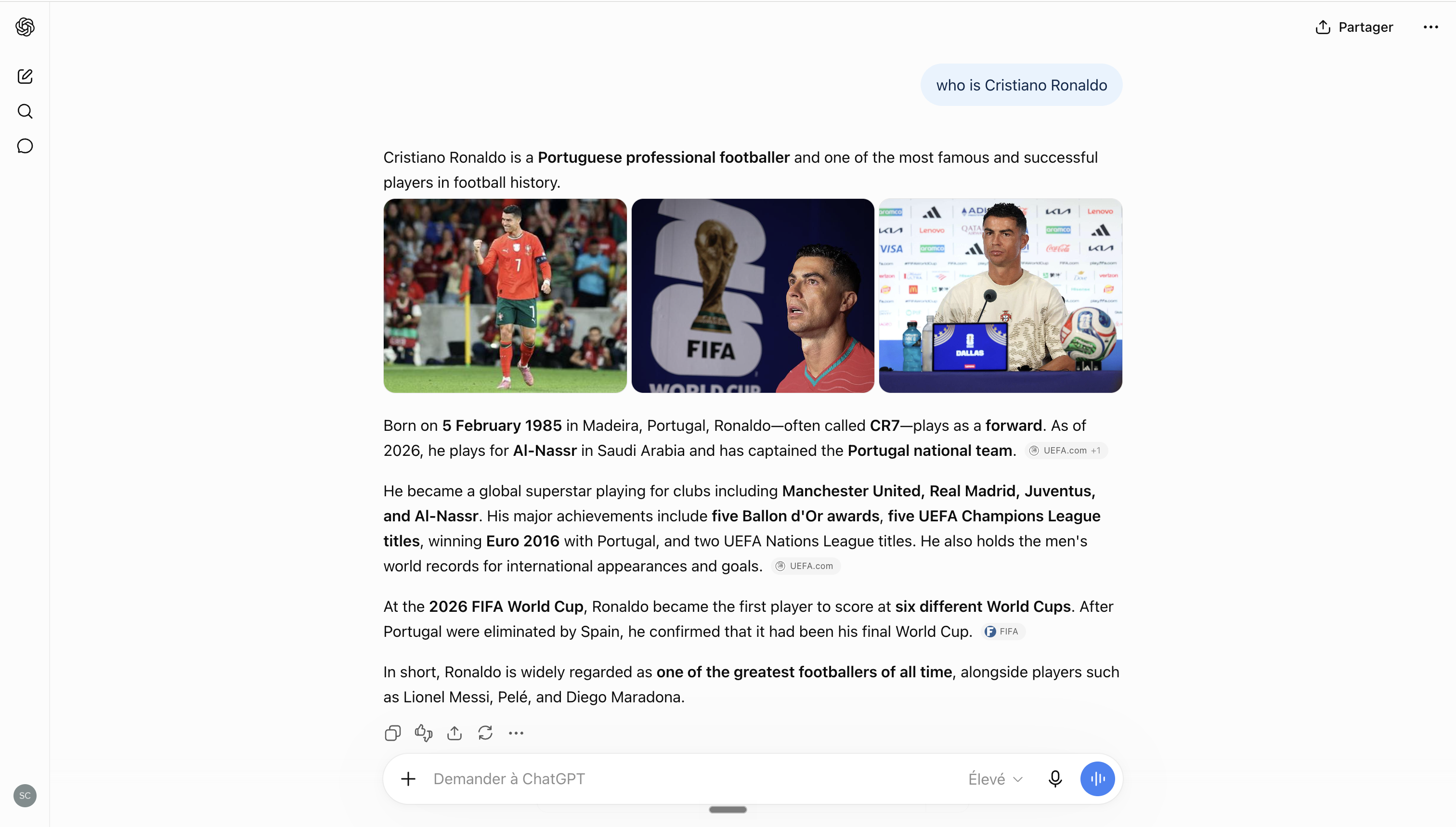
Proof that Cristiano must have read my emails on the subject
What changed
Five years ago, people googled you. They got a list of links and made up their own mind.
Today, they ask an AI. And the AI doesn't show links: it writes a summary, with total confidence. Based on whatever it finds. An old profile you never updated. An article from 2017. A forgotten comment. Sometimes someone who shares your name.
If your online trace is thin or scattered, the AI doesn't say « I don't know ». It assembles whatever is lying around, and that portrait becomes your first impression. Formed while you're not in the room.
The good news: you can take that portrait back into your own hands. And it's much simpler than people think.
The idea I've been whispering to all my friends for a month
For a few weeks now, I've been repeating the same thing to everyone around me: build yourself a personal website.
(even though I haven't built mine yet…)
Not a company website. A site under your name. firstname-lastname.com.
It's not a magic fix that solves everything. But it is, by far, the best starting point I know to take back control. Because it's the only online surface you control 100%: no platform changing its rules, no algorithm deciding your visibility. And when an AI looks up who you are, the most authoritative source about you is a site that carries your name and that you wrote yourself. It also becomes, very quickly, the first Google result for your name.
A word on how these systems work, because it explains everything. Google and AI models don't read isolated pages: they reconstruct a character. They cross-reference your LinkedIn, your Instagram, what's said about you elsewhere, and they look for consistency. If there's no reference point, they improvise with fragments. With a personal site, the hierarchy flips: your site becomes the base source, and everything else confirms it. LinkedIn, Instagram, the mentions here and there: satellites orbiting a version of you that you wrote yourself.
It's not vanity. It's deciding for yourself what people find, instead of letting the internet improvise.
What goes on it:
-
Who you are and what you do. Your profession or your firm, said in your own words.
-
Your track record. What you've built, the steps that matter.
-
Your view on your field. One page, a few paragraphs. It's what sets you apart from any generic profile.
-
Your hobbies. Seriously. It's what makes the portrait human, and it's often what people remember.
One piece of advice that counts double
Write these pages yourself.
Use AI to structure, to correct, to ask you the right questions. But the material, the words, the choices: yours. AI models (and your readers) are getting better and better at recognizing generic text that could describe anyone. What gives this site its value is precisely what only you can put into it.
The craftsman and the artist
One last thing.
An AI can describe anyone. What it will never know without you is what actually matters: what you've learned, what you've chosen to do and not to do, the perspective that twenty years in your field have given you. The description is the craftsman's work, and it just became free. The point of view is the artist. A personal website is where the artist signs.
And once you've done this for yourself, a question will come up on its own: what do your clients find when they ask an AI to recommend someone in your field?
That's the topic of the next email. Right now I see the same promise everywhere: « automate your SEO with AI, publish 1,000 articles on every topic ». You'll see very quickly that it's not worth what they make you believe, and that you're being sold a dream. But there's a real lesson in it, and it's far more interesting than the promise.
Talk soon,
The Ergon Brief
Get The Ergon Brief every week