
Applying to 1,000 jobs: the worst idea of 2026
The tools you're being sold are wrecking your applications and your hiring. Here's what to do instead.

This year, I spent dozens of hours going through applications to hire for my own company. And I realized something most candidates never see, because they've never sat on the other side of the table.
What I'm about to describe will probably change the way you apply.
And if you're hiring, stay until the end: your hiring process may have a blind spot that's costing you your best candidates.
Let's start with what really happens when your application lands.
Quick note before we start: this topic matters so much to me that I'm turning it into a full ebook. It will sell for CHF 29, like the other GenevIA books.
And like the others, it will be free for founding members. Speaking of which:
Every founding member now gets 3 free ebooks the moment they join, each normally priced at CHF 29.
-
The Prompt Guide: the complete method to get more out of one well-used AI than out of ten subscriptions
-
What Is AI, Anyway? the book that finally explains it in depth, readable at 12, useful at 40
-
The Middle Is Disappearing: our first Ergon Report, the strategic deep dive usually reserved for paying subscribers
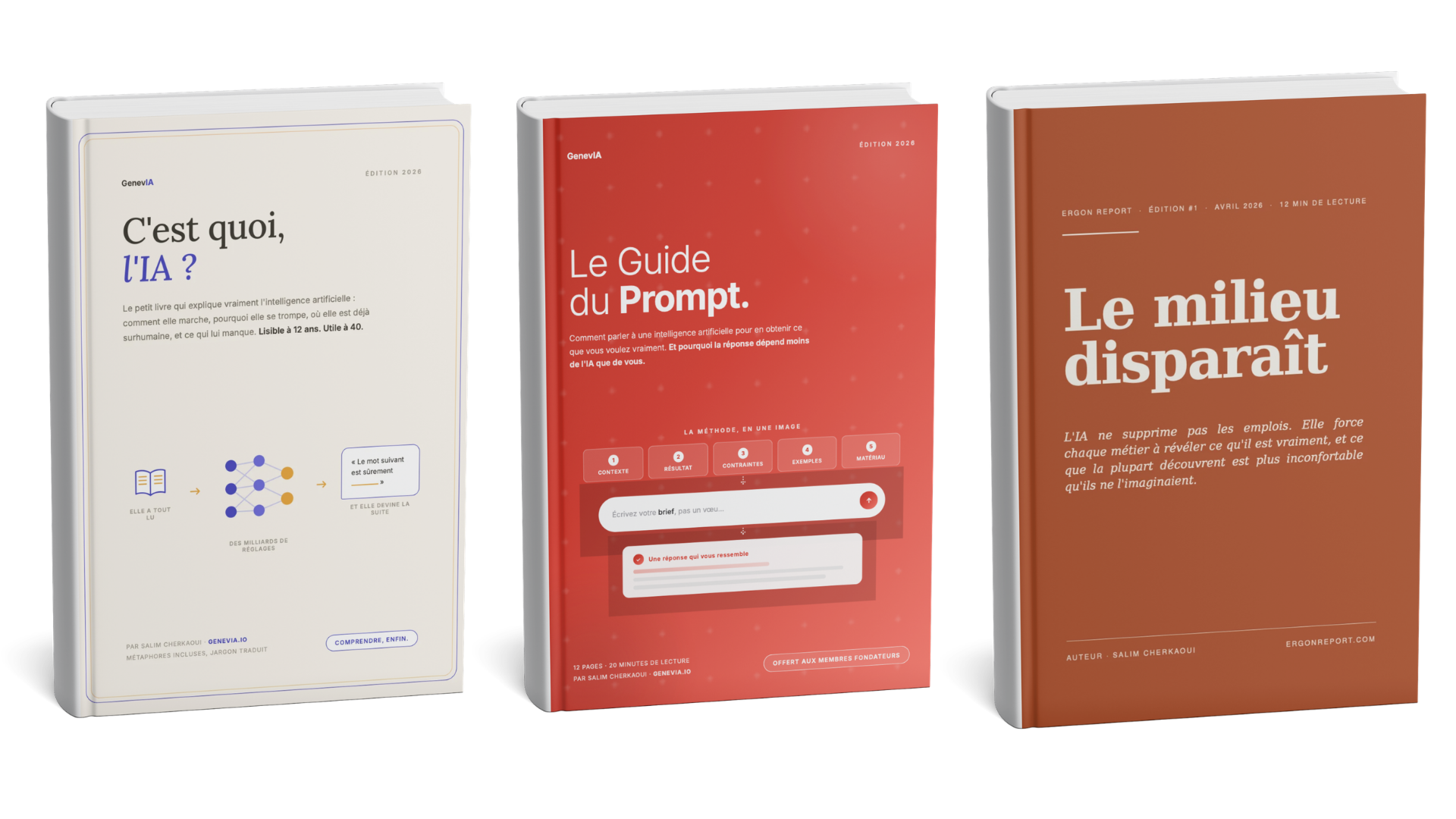
3 GenevIA ebooks, sold for CHF 29 each, free for founders
CHF 87 worth of reading for free, soon 116 with the hiring book. Nothing changes for anyone: the newsletter stays free, with no paywall, and members' money goes to one thing only: growing GenevIA.
It's CHF 3 a month, cancel in one click.
By joining, you back what I believe in: you should know exactly what AI can do for you, where it helps, and where it doesn't.
So you can see what makes you unique.
Anyway, back to hiring.
When you receive hundreds of applications, the first cut happens very fast. A few seconds per application.
And the criterion is simple:
❝
Is there a specific signal, experience that matches the job description exactly, that jumps out right away?
If yes, the application moves on. If not, it's out. Nobody has time to dig into the subtleties of a resume to guess whether the person knows how to do, or could learn to do, what's being asked.
Direct consequence: your best asset has to be visible in the first five seconds. Not on page 2, not between the lines.
You might be thinking: but that's exactly what AI tools are for, personalizing every application at scale. This is where it gets interesting, because that's precisely the trap.
"AI-personalized" applications sent to 1,000 job postings at once get spotted in ten seconds. The paradox is brutal. A personalized cover letter used to be a strong signal, because it cost time. AI has crushed that cost. So the signal is now worthless, and surface-level personalization has become a red flag.
So if volume no longer works, what does?
To answer that, you first need to see what hiring really is.
Hiring is a competition, not an exam
There's no such thing as a good resume in absolute terms.
You're not graded, you're ranked. And the response rate isn't linear: the top three applications take everything, the fortieth gets nothing.
Being first out of 5 applications beats being average out of 1,000. Every time.
So the question becomes: how do you come out on top? There's an answer, and almost nobody uses it.
Proof replaces promise
What an employer is looking for isn't someone who could do the job. It's someone who has already done it. Seeing the exact thing the role needs, already done, is the number one asset. Far ahead of everything else.
And here's the irony: the AI that killed the cover letter is exactly what lets you create that proof. In a weekend, you can:
-
Build a prototype or a live website that looks like what the role calls for
-
Analyze the company's market or product, with your concrete recommendations
-
Start a mini newsletter on the role's topic and publish three issues
-
Recreate a typical deliverable for the role: a strategy memo, a dashboard, a communications plan
A clickable link is worth a thousand adjectives. The cost of creating proof has dropped tenfold, and yet almost nobody does it.
That's the new signal: it doesn't cost money, it costs intent.
Of course, this won't work, or isn't doable, in every profession. But if you recognize yourself here, if your field lends itself to it even partly, it's a serious path to consider.
(Showing that you've mastered AI for time-consuming tasks is the other big asset. I'll dedicate an upcoming email to it, with specific examples to include in your application.)
Now, let's switch sides of the table.
If you're hiring, what follows concerns you directly, because the problem is the exact mirror image of the previous one.
Don't hire for what AI can do
Your traditional filters are dead. The clean resume, the well-written letter, the take-home test: AI does all of that. If your interviews still measure those things, you're hiring the candidate's AI, not the candidate.
-
Measure what AI can't do: judgment, taste, the ability to check a result, to ask the right question, to decide with incomplete information
-
Don't ban AI in interviews. Do the opposite. Give a real task, AI allowed, and watch how the person works with it. That's what the job actually looks like in 2026
-
Shift the weight of the evaluation: less on the application, more on live work and verifiable proof
The good news
The game is becoming honest again. When the polish is worth nothing, what counts is what you've actually done.
And for the first time, everyone has the tools to build it.
Talk soon,
Salim
P.S. If you'd like to get the GenevIA ebooks for free, and at the same time help more people discover what makes them unique in the age of AI, that's exactly what the founding member offer does.

Get The Ergon Brief every week