
5 steps to better prompts in 2026
Your 2023 prompt is costing you
There's something odd about AI. The models have changed radically in three years. The way we talk to them has barely changed at all.
We all picked up the same habits in 2023: open with "you are a world-class expert in...", add "think step by step", pile instructions into a prompt as long as your arm. Those habits worked. The problem is that today they don't. Worse, some of them actively degrade the answer.
A lot of you asked me for a step-by-step GenevIA tutorial, so here it is.
The good news is that the new method is simpler, not more complicated.
Here's how to build your new ideal prompt, step by step.
The shift: you're not prompting anymore, you're briefing
Keep this picture in mind, because everything else follows from it. A 2026 prompt isn't a magic formula. It's a brief you hand to a very capable colleague who just walked in and knows nothing about your situation.
You used to have to tell the AI how to think. Today's models already know how to think on their own. Your job has changed: you're no longer driving the mechanics, you're framing the problem. You say what to do and within what limits, and you let the machine figure out the how.
In practice, that comes down to 5 steps, but first, a quick word:
Brought to you by... us.
GenevIA Premium + DiraIA: a prompt library that knows you, deeply developed prompts, already tuned to you. One topic, one click, copied and personalized.
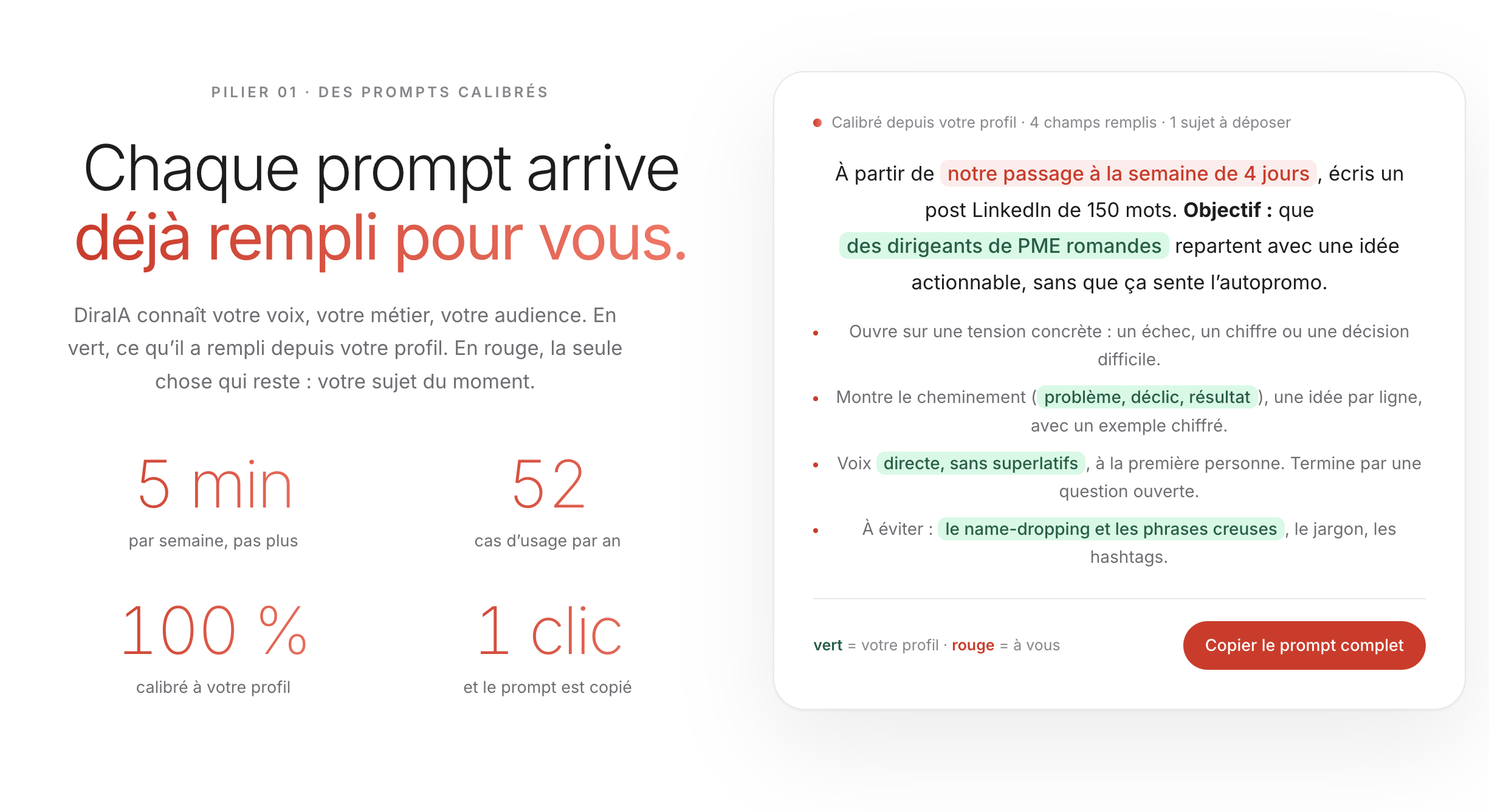
Discover GenevIA Premium + DiraIA
Back to business:
Step 1. Set the scene
Give the context before the request. Who you are, what the situation is, who the output is for. Keep it tight, but don't skip this step.
Compare the two. "Write a LinkedIn post about my company" says nothing about the audience, the goal or the tone. The AI can only produce generic mush. "I run an HR consulting firm in French-speaking Switzerland, and I'm writing for small business owners" already steers the whole answer.
Step 2. State the goal, not the method
This is the biggest shift of 2026. Say what you want to achieve, the constraints and what's at stake, rather than the procedure to follow.
Over-specifying has become counterproductive. When you dictate every step, you clip the model's reasoning ability and lose its real power. Give it the destination and the rules of the game, and let it map the route.
Step 3. Frame the constraints and the format
Once the goal is set, spell out the limits. Length, tone, what to avoid, the expected shape (table, list, three-part outline, paragraphs). AI adapts very well, as long as you tell it.
One small calibration tip, grounded in how models actually work: keep it short. A good prompt for most tasks fits in a few dense sentences, not a full page. Overly long prompts force the model to guess what really matters, and the answer gets diluted.
Step 4. Let the AI ask the questions
This is the most effective technique of the year, and almost nobody uses it. Instead of trying to anticipate everything, flip the problem around:
"I need your help with [your task in one sentence]. Before you start, ask me every question you need to understand my goal, my context, my constraints and the expected format."
The AI then comes back with eight to fifteen targeted questions. You answer them. And the final result is in a different league from what you'd have gotten on the first try. You go from placing an order to a real collaboration.
Step 5. Iterate one variable at a time
The first draft is rarely the right one, and that's normal. The real skill isn't writing the perfect prompt, it's refining it. Change a single parameter at a time (the tone, or the format, or the level of detail) and watch how the answer shifts. That's how you develop a feel for a tool.
What to stop doing, starting today
Three habits inherited from 2023 that now work against you:
"Think step by step." Recent models already do this internally. Asking again is redundant and can degrade the answer.
"You are a world-class expert in..." It sounds clever, but it often backfires. Taking on a persona improves the tone, but hurts factual accuracy: the model gets so focused on playing the expert that it forgets what it actually knows. On a standard knowledge benchmark, accuracy drops by several points with this kind of phrasing. If you want a particular style, ask for it directly: "use the style of an investigative journalist" works better than "you are a journalist".
"Whatever you do, don't make anything up." Forbidding it does nothing. What works is having it checked: ask the AI to cite sources, or even to prove that its own answer could be wrong.
Before / after
Before (the 2023 habit)
"You are a communications expert with 20 years of experience. Think step by step and write a great LinkedIn post about my new service, be creative and don't make anything up."
After (the 2026 brief)
"I'm launching an HR audit service for Swiss small businesses with 20 to 100 employees. Goal: a LinkedIn post that makes people want to contact me, no jargon, direct tone, 150 words max, ending with an open question. Before you write, ask me whatever you're missing."
The second one isn't longer. It's just better framed. And it will save you the three rounds of back-and-forth the first one would have triggered.
The bonus nobody switches on
One last lever, and it's probably the one that pays off most. By some estimates, half the time spent prompting goes into repeating the same context, over and over, in every conversation.
But the tools have memory. ChatGPT, Claude and Gemini can remember once and for all who you are, your industry, your style. You set it once in the settings, and you never have to explain it again. The quality of your answers no longer depends on the wording, but on what the tool already knows about you.
That's the big topic right now, and we'll come back to it in detail: we're moving from the art of phrasing things well to the art of feeding the AI the right context. But that's for another time.
For those who want to go further
You've just seen the method. Step 4, letting the AI ask you the questions, and the context bonus right above, is exactly what DiraIA does for you, every week, with nothing to build.
A new use case and its deeply developed prompt every week. The AI asks you two or three questions, the prompt becomes yours, and it stays yours forever. Week after week, you build a library of prompts that know you. All of it in GenevIA Premium + DiraIA, for the price of a coffee (a Grand Cappuccino in Geneva) a month.
Discover GenevIA Premium + DiraIA
GenevIA readers still get 40% off.
(The 60-second demo is on the page, and it tells the story better than I can.)
Talk soon,
Salim
Get The Ergon Brief every week